The LONVIA Edit
Curated insights on space, health, investment, and the future of living.
Inside LONVIA
The road to the first 200 lamps
The LONVIA
Edit
Curated insights on space, health, investment, and the future of living.
Inside LONVIA
The road to the first 200 lamps
8 min read

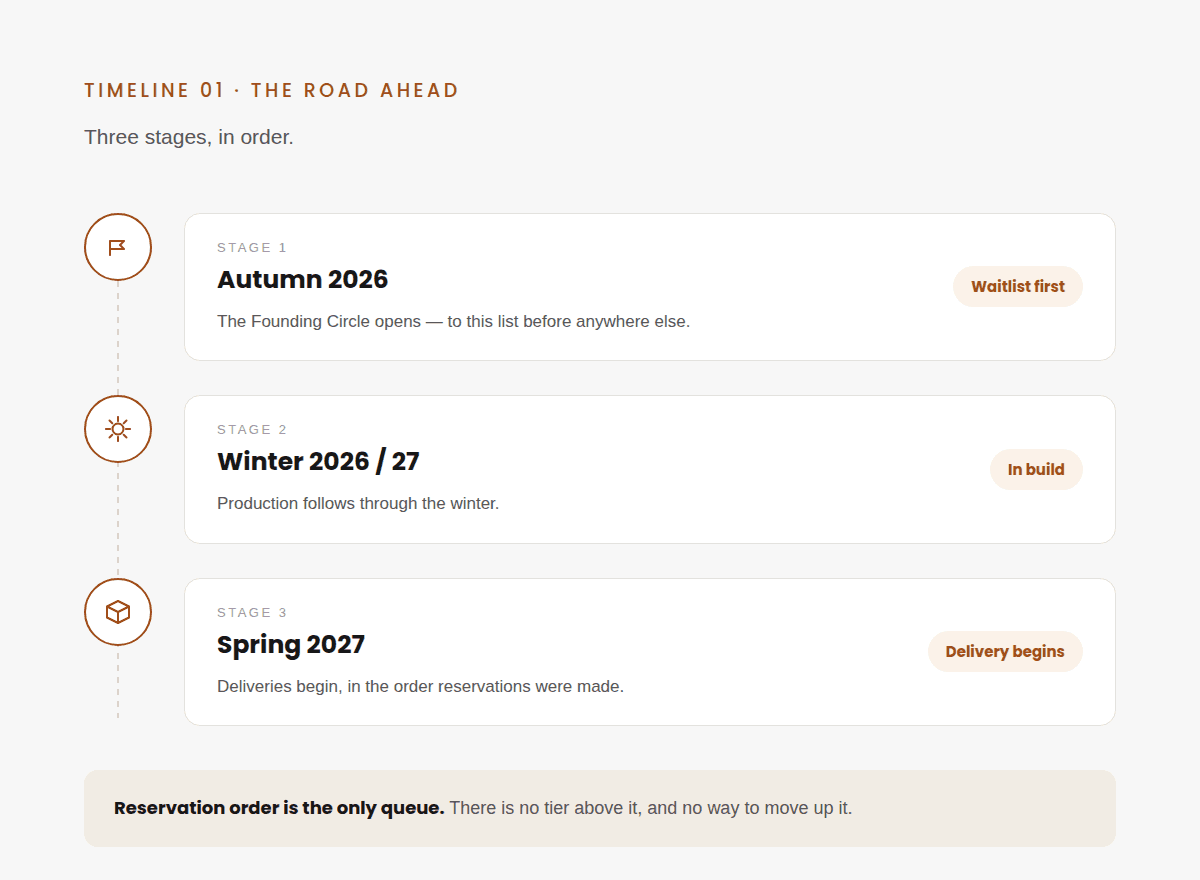
The LONVIA Lamp is at prototype stage. The work remaining is not invention. It is turning a resolved design into something that can be built repeatedly, with the five hundredth unit holding to the same standard as the first. The Founding Circle opens to the waitlist first. Production runs through the winter. Deliveries begin in reservation order.
What stage is the lamp actually at?
The design is resolved. The optical and electronic architecture is settled, and the prototype behaves as intended. The engineering questions that remain are manufacturing questions: tooling, tolerance, component supply, and the measurement regime that confirms every unit performs as specified.
One step is still outstanding and worth naming. Accredited spectral validation on a production-equivalent unit has not yet been completed. When it is, the measured figures will be published together with the method used to obtain them. Until then, nothing on this site states a performance figure for the LONVIA Lamp. That has been the standard from the first post and it does not relax because a prototype now exists.
Why is this part slow, and why is that deliberate?
A prototype has to work once. A product has to work every time, in every unit, for years, in rooms nobody has seen.
That difference is the whole of the next six months. Repeatability is harder than invention, and it is where most precision products quietly fail. A lamp specified in melanopic terms makes a promise that has to survive the production line, the component substitution, the second batch, the third supplier. If the five hundredth unit drifts from the first, the specification was decorative.
So the schedule is unhurried by choice. Cutting the validation step, or the first-article inspection, or the pilot run, would bring the date forward and remove the only thing that makes the claim worth making.
What is the road from here?
Why 200, and why not more?
The first production run is capped at 200 lamps. That number is not a marketing device. It is the size of a first run that can be inspected unit by unit, with problems caught while they are still cheap to fix.
A larger opening run would ship faster and would be measured less carefully. The cap is what makes the inspection regime possible, and the inspection regime is what the specification depends on.
What will the reservation involve?
Three things, stated plainly before anything opens.
A refundable deposit reserves one of the first 200 lamps. The balance is charged shortly before the lamp ships. The deposit is returnable in full at any time before dispatch.
Founding terms apply to these 200 lamps only. Commercial terms are communicated to the Founding Circle directly rather than published here.
Sixty days to return after delivery. A product built around how a room feels after dark should be judged in your home over several weeks, not in a showroom in ten minutes. Sixty days is roughly the period over which a change in evening light becomes noticeable in sleep data.
What is being built, and why the tolerance matters
The specification the lamp is built to comes from published consensus, not from LONVIA. Brown et al. 2022 sets a daytime minimum of 250 mEDI lux at the eye, an evening maximum of 10 mEDI lux in the three hours before sleep, and 1 mEDI lux or less during sleep. Measurement follows CIE S 026:2018.
Those are narrow targets. Around 90 per cent of the day is spent indoors, commonly under 200 mEDI lux, while a warm source at ordinary evening brightness frequently sits well above the 10 mEDI ceiling. A product that intends to correct both ends of that gap has to hold its output within a tolerance that ordinary domestic lighting has never been asked to meet.
That is why manufacturing is the slow part. The number on the page is only as good as the least accurate unit in the run.
What should you do today?
Nothing.
When the Founding Circle opens, the waitlist hears first. Questions about any of the above are welcome in the meantime, and they are read and answered individually.
With light,
Roksana Fasovska
LONVIA Founder
Frequently asked questions
When does the Founding Circle open?
Autumn 2026, to the waitlist before any public announcement. Production follows through the winter, and deliveries begin in spring 2027 in the order reservations were made.
Is the deposit refundable?
Yes. It is returnable in full at any time before the lamp is dispatched. The balance is charged shortly before shipping, not at reservation.
Why is the first run limited to 200 lamps?
It is the size of a run that can be inspected unit by unit. A larger first run would ship sooner and be measured less closely.
Can I return the lamp after it arrives?
There are sixty days from delivery to return it. Evening light is judged in the room it is used in, over weeks rather than minutes.
References
1. Brown TM, Brainard GJ, Cajochen C, et al. Recommendations for daytime, evening, and night-time indoor light exposure to best support physiology, sleep, and wakefulness in healthy adults. PLOS Biology. 2022;20(3):e3001571.
2. International Commission on Illumination (CIE). CIE S 026/E:2018. CIE System for Metrology of Optical Radiation for ipRGC-Influenced Responses to Light. Vienna: CIE; 2018.
3. Price LLA (Reporter). CIE TN 015:2023. Second International Workshop on Circadian and Neurophysiological Photoreception. Vienna: International Commission on Illumination (CIE); 2023.


Ready to shape a healthier future?
Book an introductory conversation to explore how well-being can be integrated into your space or project
Ready to shape a healthier future?
Book an introductory conversation to explore how well-being can be integrated into your space or project
Ready to shape a healthier future?
Book an introductory conversation to explore how well-being can be integrated into your space or project
8 min read
Key Insight
The LONVIA Lamp is at prototype stage. The work remaining is not invention. It is turning a resolved design into something that can be built repeatedly, with the five hundredth unit holding to the same standard as the first. The Founding Circle opens to the waitlist first. Production runs through the winter. Deliveries begin in reservation order.
The LONVIA Lamp is at prototype stage. The work remaining is not invention. It is turning a resolved design into something that can be built repeatedly, with the five hundredth unit holding to the same standard as the first. The Founding Circle opens to the waitlist first. Production runs through the winter. Deliveries begin in reservation order.
What stage is the lamp actually at?
The design is resolved. The optical and electronic architecture is settled, and the prototype behaves as intended. The engineering questions that remain are manufacturing questions: tooling, tolerance, component supply, and the measurement regime that confirms every unit performs as specified.
One step is still outstanding and worth naming. Accredited spectral validation on a production-equivalent unit has not yet been completed. When it is, the measured figures will be published together with the method used to obtain them. Until then, nothing on this site states a performance figure for the LONVIA Lamp. That has been the standard from the first post and it does not relax because a prototype now exists.
Why is this part slow, and why is that deliberate?
A prototype has to work once. A product has to work every time, in every unit, for years, in rooms nobody has seen.
That difference is the whole of the next six months. Repeatability is harder than invention, and it is where most precision products quietly fail. A lamp specified in melanopic terms makes a promise that has to survive the production line, the component substitution, the second batch, the third supplier. If the five hundredth unit drifts from the first, the specification was decorative.
So the schedule is unhurried by choice. Cutting the validation step, or the first-article inspection, or the pilot run, would bring the date forward and remove the only thing that makes the claim worth making.
Why is this part slow, and why is that deliberate?
A prototype has to work once. A product has to work every time, in every unit, for years, in rooms nobody has seen.
That difference is the whole of the next six months. Repeatability is harder than invention, and it is where most precision products quietly fail. A lamp specified in melanopic terms makes a promise that has to survive the production line, the component substitution, the second batch, the third supplier. If the five hundredth unit drifts from the first, the specification was decorative.
So the schedule is unhurried by choice. Cutting the validation step, or the first-article inspection, or the pilot run, would bring the date forward and remove the only thing that makes the claim worth making.
Why is this part slow, and why is that deliberate?
A prototype has to work once. A product has to work every time, in every unit, for years, in rooms nobody has seen.
That difference is the whole of the next six months. Repeatability is harder than invention, and it is where most precision products quietly fail. A lamp specified in melanopic terms makes a promise that has to survive the production line, the component substitution, the second batch, the third supplier. If the five hundredth unit drifts from the first, the specification was decorative.
So the schedule is unhurried by choice. Cutting the validation step, or the first-article inspection, or the pilot run, would bring the date forward and remove the only thing that makes the claim worth making.
What stage is the lamp actually at?
The design is resolved. The optical and electronic architecture is settled, and the prototype behaves as intended. The engineering questions that remain are manufacturing questions: tooling, tolerance, component supply, and the measurement regime that confirms every unit performs as specified.
One step is still outstanding and worth naming. Accredited spectral validation on a production-equivalent unit has not yet been completed. When it is, the measured figures will be published together with the method used to obtain them. Until then, nothing on this site states a performance figure for the LONVIA Lamp. That has been the standard from the first post and it does not relax because a prototype now exists.
What is the road from here?
What is the road from here?
Why 200, and why not more?
The first production run is capped at 200 lamps. That number is not a marketing device. It is the size of a first run that can be inspected unit by unit, with problems caught while they are still cheap to fix.
A larger opening run would ship faster and would be measured less carefully. The cap is what makes the inspection regime possible, and the inspection regime is what the specification depends on.
Why 200, and why not more?
The first production run is capped at 200 lamps. That number is not a marketing device. It is the size of a first run that can be inspected unit by unit, with problems caught while they are still cheap to fix.
A larger opening run would ship faster and would be measured less carefully. The cap is what makes the inspection regime possible, and the inspection regime is what the specification depends on.
What will the reservation involve?
Three things, stated plainly before anything opens.
A refundable deposit reserves one of the first 200 lamps. The balance is charged shortly before the lamp ships. The deposit is returnable in full at any time before dispatch.
Founding terms apply to these 200 lamps only. Commercial terms are communicated to the Founding Circle directly rather than published here.
Sixty days to return after delivery. A product built around how a room feels after dark should be judged in your home over several weeks, not in a showroom in ten minutes. Sixty days is roughly the period over which a change in evening light becomes noticeable in sleep data.
What will the reservation involve?
Three things, stated plainly before anything opens.
A refundable deposit reserves one of the first 200 lamps. The balance is charged shortly before the lamp ships. The deposit is returnable in full at any time before dispatch.
Founding terms apply to these 200 lamps only. Commercial terms are communicated to the Founding Circle directly rather than published here.
Sixty days to return after delivery. A product built around how a room feels after dark should be judged in your home over several weeks, not in a showroom in ten minutes. Sixty days is roughly the period over which a change in evening light becomes noticeable in sleep data.
What is being built, and why the tolerance matters
The specification the lamp is built to comes from published consensus, not from LONVIA. Brown et al. 2022 sets a daytime minimum of 250 mEDI lux at the eye, an evening maximum of 10 mEDI lux in the three hours before sleep, and 1 mEDI lux or less during sleep. Measurement follows CIE S 026:2018.
Those are narrow targets. Around 90 per cent of the day is spent indoors, commonly under 200 mEDI lux, while a warm source at ordinary evening brightness frequently sits well above the 10 mEDI ceiling. A product that intends to correct both ends of that gap has to hold its output within a tolerance that ordinary domestic lighting has never been asked to meet.
That is why manufacturing is the slow part. The number on the page is only as good as the least accurate unit in the run.
What is being built, and why the tolerance matters
The specification the lamp is built to comes from published consensus, not from LONVIA. Brown et al. 2022 sets a daytime minimum of 250 mEDI lux at the eye, an evening maximum of 10 mEDI lux in the three hours before sleep, and 1 mEDI lux or less during sleep. Measurement follows CIE S 026:2018.
Those are narrow targets. Around 90 per cent of the day is spent indoors, commonly under 200 mEDI lux, while a warm source at ordinary evening brightness frequently sits well above the 10 mEDI ceiling. A product that intends to correct both ends of that gap has to hold its output within a tolerance that ordinary domestic lighting has never been asked to meet.
That is why manufacturing is the slow part. The number on the page is only as good as the least accurate unit in the run.
What should you do today?
Nothing.
When the Founding Circle opens, the waitlist hears first. Questions about any of the above are welcome in the meantime, and they are read and answered individually.
What should you do today?
Nothing.
When the Founding Circle opens, the waitlist hears first. Questions about any of the above are welcome in the meantime, and they are read and answered individually.
Frequently asked questions
When does the Founding Circle open?
Autumn 2026, to the waitlist before any public announcement. Production follows through the winter, and deliveries begin in spring 2027 in the order reservations were made.
Is the deposit refundable?
Yes. It is returnable in full at any time before the lamp is dispatched. The balance is charged shortly before shipping, not at reservation.
Why is the first run limited to 200 lamps?
It is the size of a run that can be inspected unit by unit. A larger first run would ship sooner and be measured less closely.
Can I return the lamp after it arrives?
There are sixty days from delivery to return it. Evening light is judged in the room it is used in, over weeks rather than minutes.
References
1. Brown TM, Brainard GJ, Cajochen C, et al. Recommendations for daytime, evening, and night-time indoor light exposure to best support physiology, sleep, and wakefulness in healthy adults. PLOS Biology. 2022;20(3):e3001571.
2. International Commission on Illumination (CIE). CIE S 026/E:2018. CIE System for Metrology of Optical Radiation for ipRGC-Influenced Responses to Light. Vienna: CIE; 2018.
3. Price LLA (Reporter). CIE TN 015:2023. Second International Workshop on Circadian and Neurophysiological Photoreception. Vienna: International Commission on Illumination (CIE); 2023.
References
1. Brown TM, Brainard GJ, Cajochen C, et al. Recommendations for daytime, evening, and night-time indoor light exposure to best support physiology, sleep, and wakefulness in healthy adults. PLOS Biology. 2022;20(3):e3001571.
2. International Commission on Illumination (CIE). CIE S 026/E:2018. CIE System for Metrology of Optical Radiation for ipRGC-Influenced Responses to Light. Vienna: CIE; 2018.
3. Price LLA (Reporter). CIE TN 015:2023. Second International Workshop on Circadian and Neurophysiological Photoreception. Vienna: International Commission on Illumination (CIE); 2023.
With light,
Roksana Fasovska
Roksana Fasovska
LONVIA Founder
Inside LONVIA
The road to the first 200 lamps
8 min read
The LONVIA Lamp is at prototype stage. The work remaining is not invention. It is turning a resolved design into something that can be built repeatedly, with the five hundredth unit holding to the same standard as the first. The Founding Circle opens to the waitlist first. Production runs through the winter. Deliveries begin in reservation order.
Key Insight
What stage is the lamp actually at?
The design is resolved. The optical and electronic architecture is settled, and the prototype behaves as intended. The engineering questions that remain are manufacturing questions: tooling, tolerance, component supply, and the measurement regime that confirms every unit performs as specified.
One step is still outstanding and worth naming. Accredited spectral validation on a production-equivalent unit has not yet been completed. When it is, the measured figures will be published together with the method used to obtain them. Until then, nothing on this site states a performance figure for the LONVIA Lamp. That has been the standard from the first post and it does not relax because a prototype now exists.
Why is this part slow, and why is that deliberate?
A prototype has to work once. A product has to work every time, in every unit, for years, in rooms nobody has seen.
That difference is the whole of the next six months. Repeatability is harder than invention, and it is where most precision products quietly fail. A lamp specified in melanopic terms makes a promise that has to survive the production line, the component substitution, the second batch, the third supplier. If the five hundredth unit drifts from the first, the specification was decorative.
So the schedule is unhurried by choice. Cutting the validation step, or the first-article inspection, or the pilot run, would bring the date forward and remove the only thing that makes the claim worth making.
Why is this part slow, and why is that deliberate?
A prototype has to work once. A product has to work every time, in every unit, for years, in rooms nobody has seen.
That difference is the whole of the next six months. Repeatability is harder than invention, and it is where most precision products quietly fail. A lamp specified in melanopic terms makes a promise that has to survive the production line, the component substitution, the second batch, the third supplier. If the five hundredth unit drifts from the first, the specification was decorative.
So the schedule is unhurried by choice. Cutting the validation step, or the first-article inspection, or the pilot run, would bring the date forward and remove the only thing that makes the claim worth making.
Why is this part slow, and why is that deliberate?
A prototype has to work once. A product has to work every time, in every unit, for years, in rooms nobody has seen.
That difference is the whole of the next six months. Repeatability is harder than invention, and it is where most precision products quietly fail. A lamp specified in melanopic terms makes a promise that has to survive the production line, the component substitution, the second batch, the third supplier. If the five hundredth unit drifts from the first, the specification was decorative.
So the schedule is unhurried by choice. Cutting the validation step, or the first-article inspection, or the pilot run, would bring the date forward and remove the only thing that makes the claim worth making.
What stage is the lamp actually at?
The design is resolved. The optical and electronic architecture is settled, and the prototype behaves as intended. The engineering questions that remain are manufacturing questions: tooling, tolerance, component supply, and the measurement regime that confirms every unit performs as specified.
One step is still outstanding and worth naming. Accredited spectral validation on a production-equivalent unit has not yet been completed. When it is, the measured figures will be published together with the method used to obtain them. Until then, nothing on this site states a performance figure for the LONVIA Lamp. That has been the standard from the first post and it does not relax because a prototype now exists.
What is the road from here?
What is the road from here?
Why 200, and why not more?
The first production run is capped at 200 lamps. That number is not a marketing device. It is the size of a first run that can be inspected unit by unit, with problems caught while they are still cheap to fix.
A larger opening run would ship faster and would be measured less carefully. The cap is what makes the inspection regime possible, and the inspection regime is what the specification depends on.
Why 200, and why not more?
The first production run is capped at 200 lamps. That number is not a marketing device. It is the size of a first run that can be inspected unit by unit, with problems caught while they are still cheap to fix.
A larger opening run would ship faster and would be measured less carefully. The cap is what makes the inspection regime possible, and the inspection regime is what the specification depends on.
What will the reservation involve?
Three things, stated plainly before anything opens.
A refundable deposit reserves one of the first 200 lamps. The balance is charged shortly before the lamp ships. The deposit is returnable in full at any time before dispatch.
Founding terms apply to these 200 lamps only. Commercial terms are communicated to the Founding Circle directly rather than published here.
Sixty days to return after delivery. A product built around how a room feels after dark should be judged in your home over several weeks, not in a showroom in ten minutes. Sixty days is roughly the period over which a change in evening light becomes noticeable in sleep data.
What will the reservation involve?
Three things, stated plainly before anything opens.
A refundable deposit reserves one of the first 200 lamps. The balance is charged shortly before the lamp ships. The deposit is returnable in full at any time before dispatch.
Founding terms apply to these 200 lamps only. Commercial terms are communicated to the Founding Circle directly rather than published here.
Sixty days to return after delivery. A product built around how a room feels after dark should be judged in your home over several weeks, not in a showroom in ten minutes. Sixty days is roughly the period over which a change in evening light becomes noticeable in sleep data.
What is being built, and why the tolerance matters
The specification the lamp is built to comes from published consensus, not from LONVIA. Brown et al. 2022 sets a daytime minimum of 250 mEDI lux at the eye, an evening maximum of 10 mEDI lux in the three hours before sleep, and 1 mEDI lux or less during sleep. Measurement follows CIE S 026:2018.
Those are narrow targets. Around 90 per cent of the day is spent indoors, commonly under 200 mEDI lux, while a warm source at ordinary evening brightness frequently sits well above the 10 mEDI ceiling. A product that intends to correct both ends of that gap has to hold its output within a tolerance that ordinary domestic lighting has never been asked to meet.
That is why manufacturing is the slow part. The number on the page is only as good as the least accurate unit in the run.
What is being built, and why the tolerance matters
The specification the lamp is built to comes from published consensus, not from LONVIA. Brown et al. 2022 sets a daytime minimum of 250 mEDI lux at the eye, an evening maximum of 10 mEDI lux in the three hours before sleep, and 1 mEDI lux or less during sleep. Measurement follows CIE S 026:2018.
Those are narrow targets. Around 90 per cent of the day is spent indoors, commonly under 200 mEDI lux, while a warm source at ordinary evening brightness frequently sits well above the 10 mEDI ceiling. A product that intends to correct both ends of that gap has to hold its output within a tolerance that ordinary domestic lighting has never been asked to meet.
That is why manufacturing is the slow part. The number on the page is only as good as the least accurate unit in the run.
What should you do today?
Nothing.
When the Founding Circle opens, the waitlist hears first. Questions about any of the above are welcome in the meantime, and they are read and answered individually.
What should you do today?
Nothing.
When the Founding Circle opens, the waitlist hears first. Questions about any of the above are welcome in the meantime, and they are read and answered individually.
Frequently asked questions
When does the Founding Circle open?
Autumn 2026, to the waitlist before any public announcement. Production follows through the winter, and deliveries begin in spring 2027 in the order reservations were made.
Is the deposit refundable?
Yes. It is returnable in full at any time before the lamp is dispatched. The balance is charged shortly before shipping, not at reservation.
Why is the first run limited to 200 lamps?
It is the size of a run that can be inspected unit by unit. A larger first run would ship sooner and be measured less closely.
Can I return the lamp after it arrives?
There are sixty days from delivery to return it. Evening light is judged in the room it is used in, over weeks rather than minutes.
References
1. Brown TM, Brainard GJ, Cajochen C, et al. Recommendations for daytime, evening, and night-time indoor light exposure to best support physiology, sleep, and wakefulness in healthy adults. PLOS Biology. 2022;20(3):e3001571.
2. International Commission on Illumination (CIE). CIE S 026/E:2018. CIE System for Metrology of Optical Radiation for ipRGC-Influenced Responses to Light. Vienna: CIE; 2018.
3. Price LLA (Reporter). CIE TN 015:2023. Second International Workshop on Circadian and Neurophysiological Photoreception. Vienna: International Commission on Illumination (CIE); 2023.
References
1. Brown TM, Brainard GJ, Cajochen C, et al. Recommendations for daytime, evening, and night-time indoor light exposure to best support physiology, sleep, and wakefulness in healthy adults. PLOS Biology. 2022;20(3):e3001571.
2. International Commission on Illumination (CIE). CIE S 026/E:2018. CIE System for Metrology of Optical Radiation for ipRGC-Influenced Responses to Light. Vienna: CIE; 2018.
3. Price LLA (Reporter). CIE TN 015:2023. Second International Workshop on Circadian and Neurophysiological Photoreception. Vienna: International Commission on Illumination (CIE); 2023.
Roksana Fasovska
LONVIA Founder
With light,