Light is not decoration.
It is a biological signal.
Light is not decoration.
It is a biological signal.

Light is not decoration.
It is a biological signal.
THE SCIENCE
THE SCIENCE
THE SCIENCE
Light is not decoration.
Light is not decoration.
Light is not decoration.
It is a biological signal.
It is a biological signal.
It is a biological signal.
THE BODY CLOCK
You have a clock in nearly every cell
Deep in the brain sits the suprachiasmatic nucleus – a cluster of neurons that acts as the body's master pacemaker. It runs a near-24-hour cycle and synchronises biological timing across every organ and tissue.
Circadian markers
across 24 hours
A roughly twenty-four hour rhythm sets when you feel alert, when hormones release, how you sleep and repair. Left in the dark and it drifts. One signal keeps it aligned: light.
Your eyes do
more than see
Some cells in the eye do not form images. They tell the clock how bright the world is and what colour it is. They answer most to cool, blue-white morning light, and barely at all to warm amber and red.
THE BODY CLOCK
You have a clock in nearly every cell
Deep in the brain sits the suprachiasmatic nucleus – a cluster of neurons that acts as the body's master pacemaker. It runs a near-24-hour cycle and synchronises biological timing across every organ and tissue.
Circadian markers
across 24 hours
A roughly twenty-four hour rhythm sets when you feel alert, when hormones release, how you sleep and repair. Left in the dark and it drifts. One signal keeps it aligned: light.
Your eyes do
more than see
Some cells in the eye do not form images. They tell the clock how bright the world is and what colour it is. They answer most to cool, blue-white morning light, and barely at all to warm amber and red.
THE BODY CLOCK
You have a clock in nearly every cell
Deep in the brain sits the suprachiasmatic nucleus – a cluster of neurons that acts as the body's master pacemaker. It runs a near-24-hour cycle and synchronises biological timing across every organ and tissue.
Circadian markers
across 24 hours
A roughly twenty-four hour rhythm sets when you feel alert, when hormones release, how you sleep and repair. Left in the dark and it drifts. One signal keeps it aligned: light.
Your eyes do
more than see
Some cells in the eye do not form images. They tell the clock how bright the world is and what colour it is. They answer most to cool, blue-white morning light, and barely at all to warm amber and red.
THE BODY CLOCK
You have a clock in nearly every cell
Deep in the brain sits the suprachiasmatic nucleus – a cluster of neurons that acts as the body's master pacemaker. It runs a near-24-hour cycle and synchronises biological timing across every organ and tissue.
Circadian markers
across 24 hours
A roughly twenty-four hour rhythm sets when you feel alert, when hormones release, how you sleep and repair. Left in the dark and it drifts. One signal keeps it aligned: light.
Your eyes do
more than see
Some cells in the eye do not form images. They tell the clock how bright the world is and what colour it is. They answer most to cool, blue-white morning light, and barely at all to warm amber and red.
THE PROBLEM
The body asks for different light
at different hours
The body asks for different light at
different hours
The body asks for different light at different hours
The body asks for different light at different hours
The body asks for different light at
different hours
Most light is built to be seen, not to be lived under. A standard light stays roughly the same all day. So it is too dim for the morning the body needs, and too bright for the night it needs. One fixed light cannot do both jobs.

LIGHT ACROSS THE DAY
What a healthy day of light looks like
What a healthy day of light looks like
There is no single correct light. There is a correct light for each phase. These are the jobs light is meant to do.
Four moments in the day when light should change –
and how LONVIA responds in each,
from morning clarity to evening calm.

MORNING
Wake
The body's most critical light moment. A strong signal clears the night hormone, raises cortisol, and sets the biological clock for everything that follows.
MORNING
Wake
The body's most critical light moment. A strong signal clears the night hormone, raises cortisol, and sets the biological clock for everything that follows.
MORNING
Wake
The body's most critical light moment. A strong signal clears the night hormone, raises cortisol, and sets the biological clock for everything that follows.

DAYTIME
Sustain
Full-spectrum light holds alertness, mood and cognitive rhythm through working hours. Without it, the clock begins to drift.
DAYTIME
Sustain
Full-spectrum light holds alertness, mood and cognitive rhythm through working hours. Without it, the clock begins to drift.
DAYTIME
Sustain
Full-spectrum light holds alertness, mood and cognitive rhythm through working hours. Without it, the clock begins to drift.
EVENING
Wind down
Warm, amber light lets melatonin rise on schedule. The cells that control the body clock barely respond to it, as nature intended.
EVENING
Wind down
Warm, amber light lets melatonin rise on schedule. The cells that control the body clock barely respond to it, as nature intended.
EVENING
Wind down
Warm, amber light lets melatonin rise on schedule. The cells that control the body clock barely respond to it, as nature intended.
NIGHT
Rest
Almost any light reads as daytime to the biological clock. The goal is near-darkness: visible to the eye, with minimal effect on the body clock.
NIGHT
Rest
Almost any light reads as daytime to the biological clock. The goal is near-darkness: visible to the eye, with minimal effect on the body clock.
NIGHT
Rest
Almost any light reads as daytime to the biological clock. The goal is near-darkness: visible to the eye, with minimal effect on the body clock.
THE METRIC THAT MATTERS
Lux measures brightness.
mEDI measures biology
Lux measures brightness. mEDI measures biology
Lux measures brightness. mEDI measures biology
Lux measures brightness. mEDI measures biology
Lux tells you how bright a room looks. It says nothing about effect. mEDI measures the light the clock actually responds to. The two are not the same, as the curves below show.
WHY WE BUILT THIS
One lamp, engineered to the science
One lamp, engineered to the science
Most light products address one phase of the day and approximate the rest. LONVIA was built to do something more demanding: the biologically correct light at every hour.
Morning, daytime, evening, night. Each phase calibrated precisely, not adjusted for convenience.
No shortcuts in the spectrum. No compromises in the engineering. One lamp. The full biological day. Built properly.
WHY WE BUILT THIS
One lamp, engineered to the science
Most light products address one phase of the day and approximate the rest. LONVIA was built to do something more demanding: the biologically correct light at every hour.
Morning, daytime, evening, night. Each phase calibrated precisely, not adjusted for convenience.
No shortcuts in the spectrum. No compromises in the engineering. One lamp. The full biological day. Built properly.

THE RESEARCH
THE RESEARCH
Most light is built to be seen,
not to be lived under
Most light is built to be seen, not to be
lived under
Most light is built to be seen, not to be
lived under
Most light is built to be seen, not to be lived under
A consensus of circadian scientists put numbers to it.
These thresholds describe the goal for any person, in any room.
Light, temperature, and environment
don't just affect how comfortable
a space feels – they govern your sleep, cognition, and long-term health.
The evidence is precise.
> 0
> 0
Daytime · mEDI
The minimum biological light the body needs through the day to hold a rhythm.
Brown et al., 2022
> 0
> 0
Daytime · mEDI
The minimum biological light the body needs through the day to hold a rhythm.
Brown et al., 2022
< 0
< 0
Before sleep · mEDI
The ceiling in the hours before bed, low enough to let the natural wind-down begin.
Brown et al., 2022
< 0
< 0
Before sleep · mEDI
The ceiling in the hours before bed, low enough to let the natural wind-down begin.
Brown et al., 2022
Dark
Night
As close to no biological signal as the room allows, so the clock is left undisturbed.
Published consensus
Dark
Night
As close to no biological signal as the room allows, so the clock is left undisturbed.
Published consensus
The standard for measuring melanopic light
Which light suppresses the night hormone
How sensitive the clock is to evening light
Measuring light in the melanopsin age
Recommended light for day, evening and night
Daylight at work, better sleep at home
INSIGHTS
The LONVIA Journal
The LONVIA Journal
Curated reading on circadian science, sleep, and living well.
Curated reading on circadian science, sleep, and living well.

Circadian Science
The daytime light deficit most homes never fix
Most homes give the body a fraction of the daytime light its clock needs. The camping studies that reveal the gap, the window studies that show the cost, and how to close it.
Circadian Science
The daytime light deficit most homes never fix
Most homes give the body a fraction of the daytime light its clock needs. The camping studies that reveal the gap, the window studies that show the cost, and how to close it.
Science
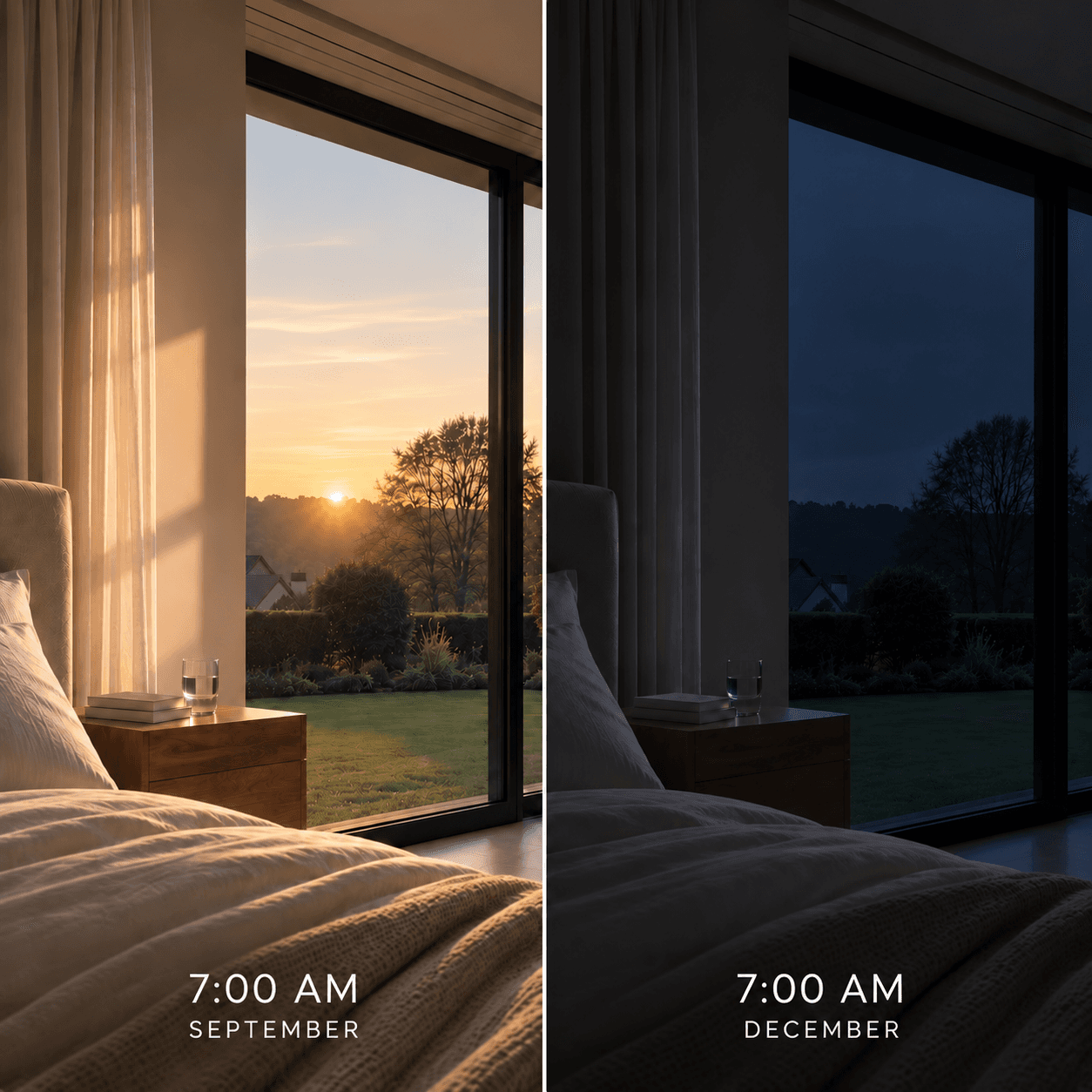
The mornings change first: what the autumn equinox does to your light
The autumn equinox falls on 23 September 2026. Why the mornings darken before the evenings, how much daylight is lost each day by latitude, and three things to do about it this week.
Science
The mornings change first: what the autumn equinox does to your light
The autumn equinox falls on 23 September 2026. Why the mornings darken before the evenings, how much daylight is lost each day by latitude, and three things to do about it this week.

Science
Your home has two lighting problems, and they are opposites
Homes deliver too little biological light by day and too much after dark. What the 250 and 10 mEDI thresholds require, why one fixed fitting cannot do both, and two changes you can make tonight.
Science
Your home has two lighting problems, and they are opposites
Homes deliver too little biological light by day and too much after dark. What the 250 and 10 mEDI thresholds require, why one fixed fitting cannot do both, and two changes you can make tonight.
Circadian Science
The daytime light deficit most homes never fix
Most homes give the body a fraction of the daytime light its clock needs. The camping studies that reveal the gap, the window studies that show the cost, and how to close it.
Science
The mornings change first: what the autumn equinox does to your light
The autumn equinox falls on 23 September 2026. Why the mornings darken before the evenings, how much daylight is lost each day by latitude, and three things to do about it this week.

FOUNDING CIRCLE
Reserve the first LONVIA Lamp
The Founding Circle is open.
Founding member price €1,295.
For the first 200 reservations.
The Founding Circle is open.
Founding member price €1,295.
For the first 200 reservations.
Reserve now. Pay in January.
Receive March 2027.
FOUNDING CIRCLE
Reserve the first
LONVIA Lamp
The Founding Circle is open.
Founding member price €1,295.
For the first 200 reservations.
The Founding Circle is open.
Founding member price €1,295.
For the first 200 reservations.
Reserve now. Pay in January.
Receive March 2027.
FOUNDING CIRCLE
Reserve the first LONVIA Lamp
The Founding Circle is open.
Founding member price €1,295.
For the first 200 reservations.
The Founding Circle is open.
Founding member price €1,295.
For the first 200 reservations.
Reserve now. Pay in January.
Receive March 2027.