The LONVIA Edit
Curated insights on space, health, investment, and the future of living.
Circadian Science
The daytime light deficit most homes never fix
The LONVIA
Edit
Curated insights on space, health, investment, and the future of living.
Circadian Science
The daytime light deficit most homes never fix
7 min read

Most homes and offices give the body far less daytime light than its clock needs. Outdoors on a bright day, the eye receives 10,000 lux and more. A typical lit room offers only a few hundred, around 100 times less. And we now spend around 90% of our lives indoors, leaving most people in a chronic daytime light deficit. The result is a weaker day-night rhythm, lower daytime alertness, and a tendency for sleep to drift later.
Almost everything written about light and sleep is about the evening. Cut the blue light, dim the screens, warm the bulbs. The advice is sound as far as it goes, but it stares at one end of the day and ignores the other, where the bigger problem quietly sits. For most people the trouble is not only too much light at night. It is far too little by day.
This is the daytime light deficit. It is easy to miss for one reason: the rooms look fine. They are perfectly bright enough to see in, to work in, to live in. The eye, which adjusts constantly, reassures you that all is well. The clock, which does not report to you at all, disagrees.
The number your eye is hiding from you
The gap between outdoor and indoor light is far larger than anyone intuitively believes, because vision is built to hide it. Step outside on a clear day and the illuminance at your eye runs into the tens of thousands of lux, over a hundred thousand in direct sun. A comfortably lit indoor room, by contrast, sits somewhere around a few hundred. That is a difference not of a little but of a hundredfold or more. Your visual system compresses that enormous range into a roughly similar sense of brightness, so a dim office and a bright garden feel much closer than they are. The eye is a superb camera and a terrible light meter, and it has been quietly reassuring you that your rooms are bright when, to the clock, they are closer to dusk.
Layer on how we spend our hours. One long-running national activity survey put the share of life spent indoors at close to ninety per cent (Klepeis and colleagues, 2001). We are, functionally, an indoor species now, reading a light environment our biology never met until a few generations ago. The eye evolved under a daily arc from near-darkness to blazing noon. We have replaced it with a narrow, dim, more or less constant band, and then wondered why sleep is hard to come by.

What a week in a tent reveals
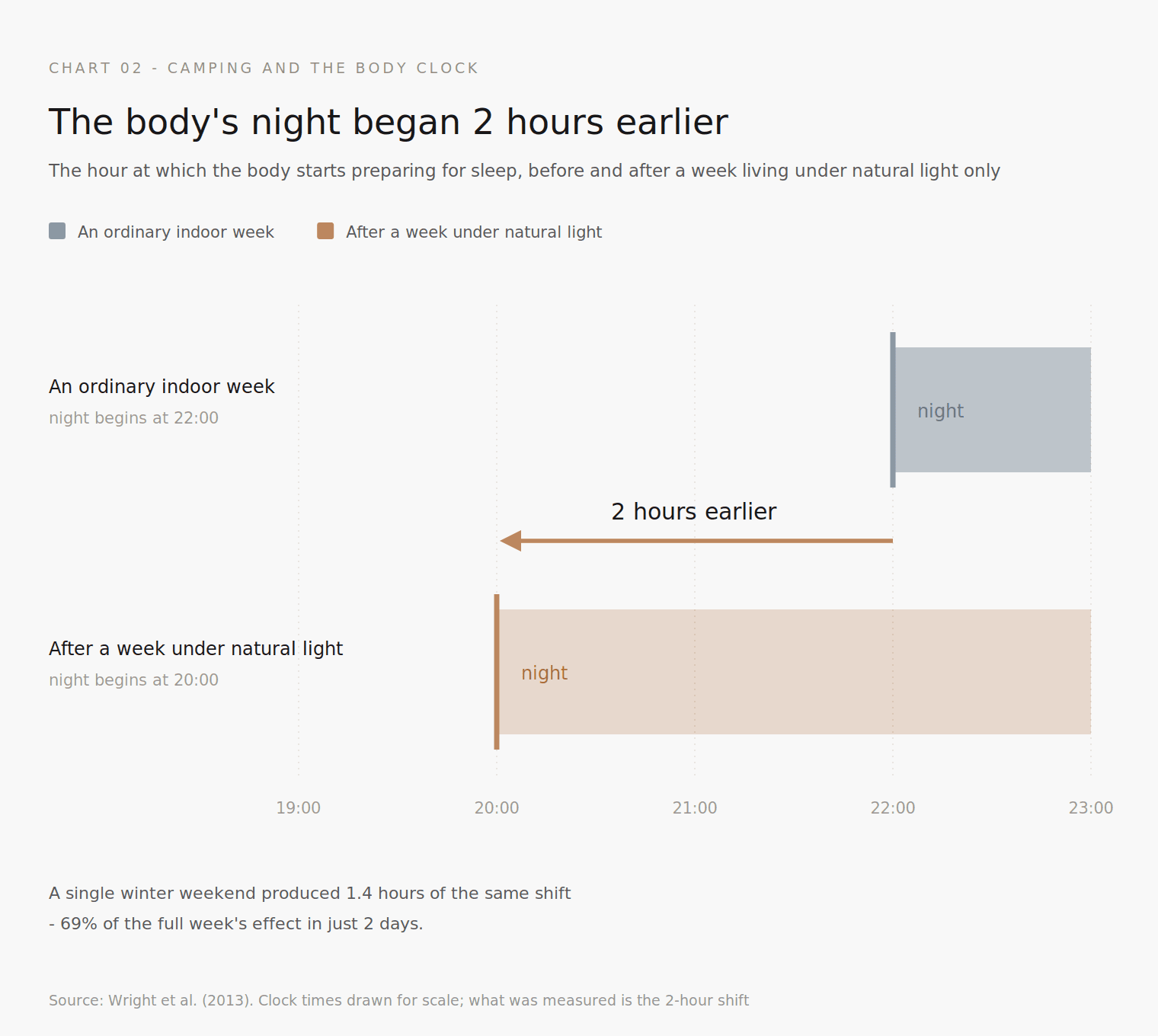
The cleanest demonstration of what we are missing comes not from a laboratory but from a series of camping trips. In 2013, Kenneth Wright's team at Colorado sent volunteers into the mountains for a week in summer with no torches, no phones, no artificial light at all, only the sun and the campfire. Out there, the participants received roughly four times more light during the day than in their normal lives. When they came back, the onset of their melatonin, the body's night signal, had shifted almost two hours earlier, and their clocks had locked neatly onto the sun. People who described themselves as night owls became, within a week, ordinary early risers.
A follow-up study made the point even sharper. Ellen Stothard and colleagues (2017) sent people camping for a single winter weekend. Out in the snow they received about thirteen times more daylight than in their normal indoor week, and after just two days their melatonin timing had moved 1.4 hours earlier, roughly sixty-nine per cent of the shift the full week had produced. Two days outdoors undid most of the drift that modern indoor life had built up. The conclusion is uncomfortable and clear: the deficit is real, it is large, and the body corrects it fast the moment it gets proper daylight.
Why the day matters, not just the night
It is tempting to think of daylight as merely the opposite of evening darkness, but the clock does not work by darkness alone. It runs on contrast. A strong, unambiguous day is what allows a strong, unambiguous night; blur the day and you blur the whole rhythm, evenings included. A body that never receives a clear daytime signal is a body running on a low-contrast version of time, with the boundary between day and night smeared at both ends.
This is why the leading consensus recommendations set a daytime floor and not only an evening ceiling. Circadian scientists, led by Timothy Brown in 2022, recommend that day-active adults receive at least 250 melanopic lux at the eye during the daytime. The number is not arbitrary. It sits near the point where the biological day signal saturates, where the system is being told, unmistakably, that it is day. The trouble is how far ordinary life falls below it. Reviews estimate that through much of the day most people sit somewhere between thirty and sixty per cent under that 250 minimum, and measured office environments routinely fall short. The deficit is not a rare pathology. It is the normal condition of a room lit for the eye rather than the clock.

What the window seat is worth
If the deficit is invisible, its cost is not, and the most telling evidence comes from something as mundane as where your desk sits. In a study of office workers, Mohamed Boubekri and colleagues (2014) compared people with windows against those in windowless spaces. The workers with windows received 173 per cent more light during working hours and slept, on average, forty-six minutes more each night, with better sleep quality and higher vitality scores. A later study by the same group (2020) found that workers given optimised daylight and views slept thirty-seven minutes longer and scored forty-two per cent higher on tests of higher-order decision-making. A parallel study in classrooms found that children with plenty of daylight slept around thirty-six minutes longer than those in dim rooms.
Forty-six minutes of sleep is not a rounding error; it is the difference a whole category of sleep products chases and rarely delivers, produced here by nothing more than a window. There is a design footnote worth keeping, though. Daylight from a side window falls away sharply, and by around twenty to twenty-five feet in from the glass it has all but vanished. A window in the room is not the same as daylight at your eyes. Proximity is most of the benefit.
How to close the gap
The simplest correction is the oldest one. Time outdoors, particularly in the morning, raises daytime exposure more than any indoor adjustment can, because even a grey, overcast sky vastly outstrips indoor lighting. Working near a window helps for the same reason, within that twenty-foot limit. Where daylight genuinely is not available, brighter indoor light during the day narrows the gap, and here placement matters as much as output, because light falls away steeply with distance: a source near you, roughly at eye level, delivers far more to the clock than the same source across the room or overhead. None of this demands precision at the outset. It demands noticing that a room bright enough to read in is usually not bright enough for the system that keeps your time.
The honest limits
Two cautions keep this accurate. The first is that the real-world evidence, while pointing consistently in one direction, is still uneven. Field studies linking everyday light exposure to mood and performance have been mixed, partly because many measured ordinary brightness rather than the melanopic quantity that actually matters, and the daytime recommendations are still being validated outside the laboratory. The direction is well supported; the precise size of the everyday gain is not settled. The second caution is that more light is not a blanket good. The aim is a strong day and a quiet night, not maximum light at all hours. The same brightness that helps at noon works against you at eleven, because the clock reads timing as sharply as it reads level. The fix for the daytime deficit is a better-shaped day, not simply a brighter one.
Still, the shape of the problem is not really in doubt. We built ourselves a world of comfortable, even, indoor light, and in doing so we deleted the very thing the clock was built to read: a bright, unmistakable day. The campers found it again in a weekend. Most of us could find a good deal of it by morning, near a window, with the blinds up.
With light,
Roksana Fasovska
LONVIA Founder
Frequently asked questions
How much daytime light do I need for my circadian rhythm?
Consensus recommendations for day-active adults advise at least 250 melanopic lux at eye level during the day (Brown and colleagues, 2022), well above what most indoor rooms provide.
Is my home or office bright enough for my body clock?
Usually not. Indoor lighting is set for vision, which needs far less than the clock does, and reviews suggest most people spend much of the day thirty to sixty per cent below the recommended daytime minimum.
Does getting more daylight actually improve sleep?
Studies point that way. Office workers with more daylight slept around forty-six minutes longer in one study, and camping trips that greatly increase daylight shift the clock earlier within days.
What is the easiest way to fix a daytime light deficit?
Daylight. Time outdoors, especially in the morning, and sitting within about twenty feet of a window raise daytime exposure far more than typical indoor lighting can.
References
1. Klepeis NE, Nelson WC, Ott WR, et al. The National Human Activity Pattern Survey (NHAPS): a resource for assessing exposure to environmental pollutants. Journal of Exposure Analysis and Environmental Epidemiology. 2001;11(3):231-252.
2. Espiritu RC, Kripke DF, Ancoli-Israel S, et al. Low illumination experienced by San Diego adults: association with atypical depressive symptoms. Biological Psychiatry. 1994;35(6):403-407.
3. Wright KP Jr, McHill AW, Birks BR, Griffin BR, Rusterholz T, Chinoy ED. Entrainment of the human circadian clock to the natural light-dark cycle. Current Biology. 2013;23(16):1554-1558.
4. Stothard ER, McHill AW, Depner CM, et al. Circadian entrainment to the natural light-dark cycle across seasons and the weekend. Current Biology. 2017;27(4):508-513.
5. Boubekri M, Cheung IN, Reid KJ, Wang CH, Zee PC. Impact of windows and daylight exposure on overall health and sleep quality of office workers: a case-control pilot study. Journal of Clinical Sleep Medicine. 2014;10(6):603-611.
6. Boubekri M, Lee J, MacNaughton P, et al. The impact of optimized daylight and views on the sleep duration and cognitive performance of office workers. International Journal of Environmental Research and Public Health. 2020;17(9):3219.
7. Lucas RJ, Peirson SN, Berson DM, et al. Measuring and using light in the melanopsin age. Trends in Neurosciences. 2014;37(1):1-9.
8. International Commission on Illumination. CIE S 026/E:2018. CIE System for Metrology of Optical Radiation for ipRGC-Influenced Responses to Light. Vienna: CIE; 2018.
9. Brown TM, Brainard GC, Cajochen C, et al. Recommendations for daytime, evening, and night-time indoor light exposure to best support physiology, sleep, and wakefulness in healthy adults. PLoS Biology. 2022;20(3):e3001571.

Ready to shape a healthier future?
Book an introductory conversation to explore how well-being can be integrated into your space or project.
Ready to shape a healthier future?
Book an introductory conversation to explore how well-being can be integrated into your space or project.
Ready to shape a healthier future?
Book an introductory conversation to explore how well-being can be integrated into your space or project.
7 min read
Key Insight
Most homes and offices give the body far less daytime light than its clock needs. Outdoors on a bright day, the eye receives 10,000 lux and more. A typical lit room offers only a few hundred, around 100 times less. And we now spend around 90% of our lives indoors, leaving most people in a chronic daytime light deficit. The result is a weaker day-night rhythm, lower daytime alertness, and a tendency for sleep to drift later.
Most homes and offices give the body far less daytime light than its clock needs. Outdoors on a bright day, the eye receives 10,000 lux and more. A typical lit room offers only a few hundred, around 100 times less. And we now spend around 90% of our lives indoors, leaving most people in a chronic daytime light deficit. The result is a weaker day-night rhythm, lower daytime alertness, and a tendency for sleep to drift later.
Almost everything written about light and sleep is about the evening. Cut the blue light, dim the screens, warm the bulbs. The advice is sound as far as it goes, but it stares at one end of the day and ignores the other, where the bigger problem quietly sits. For most people the trouble is not only too much light at night. It is far too little by day.
This is the daytime light deficit. It is easy to miss for one reason: the rooms look fine. They are perfectly bright enough to see in, to work in, to live in. The eye, which adjusts constantly, reassures you that all is well. The clock, which does not report to you at all, disagrees.
The number your eye is hiding from you
The gap between outdoor and indoor light is far larger than anyone intuitively believes, because vision is built to hide it. Step outside on a clear day and the illuminance at your eye runs into the tens of thousands of lux, over a hundred thousand in direct sun. A comfortably lit indoor room, by contrast, sits somewhere around a few hundred. That is a difference not of a little but of a hundredfold or more. Your visual system compresses that enormous range into a roughly similar sense of brightness, so a dim office and a bright garden feel much closer than they are. The eye is a superb camera and a terrible light meter, and it has been quietly reassuring you that your rooms are bright when, to the clock, they are closer to dusk.
Layer on how we spend our hours. One long-running national activity survey put the share of life spent indoors at close to ninety per cent (Klepeis and colleagues, 2001). We are, functionally, an indoor species now, reading a light environment our biology never met until a few generations ago. The eye evolved under a daily arc from near-darkness to blazing noon. We have replaced it with a narrow, dim, more or less constant band, and then wondered why sleep is hard to come by.
The number your eye is hiding from you
The gap between outdoor and indoor light is far larger than anyone intuitively believes, because vision is built to hide it. Step outside on a clear day and the illuminance at your eye runs into the tens of thousands of lux, over a hundred thousand in direct sun. A comfortably lit indoor room, by contrast, sits somewhere around a few hundred. That is a difference not of a little but of a hundredfold or more. Your visual system compresses that enormous range into a roughly similar sense of brightness, so a dim office and a bright garden feel much closer than they are. The eye is a superb camera and a terrible light meter, and it has been quietly reassuring you that your rooms are bright when, to the clock, they are closer to dusk.
Layer on how we spend our hours. One long-running national activity survey put the share of life spent indoors at close to ninety per cent (Klepeis and colleagues, 2001). We are, functionally, an indoor species now, reading a light environment our biology never met until a few generations ago. The eye evolved under a daily arc from near-darkness to blazing noon. We have replaced it with a narrow, dim, more or less constant band, and then wondered why sleep is hard to come by.
The number your eye is hiding from you
The gap between outdoor and indoor light is far larger than anyone intuitively believes, because vision is built to hide it. Step outside on a clear day and the illuminance at your eye runs into the tens of thousands of lux, over a hundred thousand in direct sun. A comfortably lit indoor room, by contrast, sits somewhere around a few hundred. That is a difference not of a little but of a hundredfold or more. Your visual system compresses that enormous range into a roughly similar sense of brightness, so a dim office and a bright garden feel much closer than they are. The eye is a superb camera and a terrible light meter, and it has been quietly reassuring you that your rooms are bright when, to the clock, they are closer to dusk.
Layer on how we spend our hours. One long-running national activity survey put the share of life spent indoors at close to ninety per cent (Klepeis and colleagues, 2001). We are, functionally, an indoor species now, reading a light environment our biology never met until a few generations ago. The eye evolved under a daily arc from near-darkness to blazing noon. We have replaced it with a narrow, dim, more or less constant band, and then wondered why sleep is hard to come by.
Almost everything written about light and sleep is about the evening. Cut the blue light, dim the screens, warm the bulbs. The advice is sound as far as it goes, but it stares at one end of the day and ignores the other, where the bigger problem quietly sits. For most people the trouble is not only too much light at night. It is far too little by day.
This is the daytime light deficit. It is easy to miss for one reason: the rooms look fine. They are perfectly bright enough to see in, to work in, to live in. The eye, which adjusts constantly, reassures you that all is well. The clock, which does not report to you at all, disagrees.
What a week in a tent reveals
The cleanest demonstration of what we are missing comes not from a laboratory but from a series of camping trips. In 2013, Kenneth Wright's team at Colorado sent volunteers into the mountains for a week in summer with no torches, no phones, no artificial light at all, only the sun and the campfire. Out there, the participants received roughly four times more light during the day than in their normal lives. When they came back, the onset of their melatonin, the body's night signal, had shifted almost two hours earlier, and their clocks had locked neatly onto the sun. People who described themselves as night owls became, within a week, ordinary early risers.
A follow-up study made the point even sharper. Ellen Stothard and colleagues (2017) sent people camping for a single winter weekend. Out in the snow they received about thirteen times more daylight than in their normal indoor week, and after just two days their melatonin timing had moved 1.4 hours earlier, roughly sixty-nine per cent of the shift the full week had produced. Two days outdoors undid most of the drift that modern indoor life had built up. The conclusion is uncomfortable and clear: the deficit is real, it is large, and the body corrects it fast the moment it gets proper daylight.
What a week in a tent reveals
The cleanest demonstration of what we are missing comes not from a laboratory but from a series of camping trips. In 2013, Kenneth Wright's team at Colorado sent volunteers into the mountains for a week in summer with no torches, no phones, no artificial light at all, only the sun and the campfire. Out there, the participants received roughly four times more light during the day than in their normal lives. When they came back, the onset of their melatonin, the body's night signal, had shifted almost two hours earlier, and their clocks had locked neatly onto the sun. People who described themselves as night owls became, within a week, ordinary early risers.
A follow-up study made the point even sharper. Ellen Stothard and colleagues (2017) sent people camping for a single winter weekend. Out in the snow they received about thirteen times more daylight than in their normal indoor week, and after just two days their melatonin timing had moved 1.4 hours earlier, roughly sixty-nine per cent of the shift the full week had produced. Two days outdoors undid most of the drift that modern indoor life had built up. The conclusion is uncomfortable and clear: the deficit is real, it is large, and the body corrects it fast the moment it gets proper daylight.
Why the day matters, not just the night
It is tempting to think of daylight as merely the opposite of evening darkness, but the clock does not work by darkness alone. It runs on contrast. A strong, unambiguous day is what allows a strong, unambiguous night; blur the day and you blur the whole rhythm, evenings included. A body that never receives a clear daytime signal is a body running on a low-contrast version of time, with the boundary between day and night smeared at both ends.
This is why the leading consensus recommendations set a daytime floor and not only an evening ceiling. Circadian scientists, led by Timothy Brown in 2022, recommend that day-active adults receive at least 250 melanopic lux at the eye during the daytime. The number is not arbitrary. It sits near the point where the biological day signal saturates, where the system is being told, unmistakably, that it is day. The trouble is how far ordinary life falls below it. Reviews estimate that through much of the day most people sit somewhere between thirty and sixty per cent under that 250 minimum, and measured office environments routinely fall short. The deficit is not a rare pathology. It is the normal condition of a room lit for the eye rather than the clock.
Why the day matters, not just the night
It is tempting to think of daylight as merely the opposite of evening darkness, but the clock does not work by darkness alone. It runs on contrast. A strong, unambiguous day is what allows a strong, unambiguous night; blur the day and you blur the whole rhythm, evenings included. A body that never receives a clear daytime signal is a body running on a low-contrast version of time, with the boundary between day and night smeared at both ends.
This is why the leading consensus recommendations set a daytime floor and not only an evening ceiling. Circadian scientists, led by Timothy Brown in 2022, recommend that day-active adults receive at least 250 melanopic lux at the eye during the daytime. The number is not arbitrary. It sits near the point where the biological day signal saturates, where the system is being told, unmistakably, that it is day. The trouble is how far ordinary life falls below it. Reviews estimate that through much of the day most people sit somewhere between thirty and sixty per cent under that 250 minimum, and measured office environments routinely fall short. The deficit is not a rare pathology. It is the normal condition of a room lit for the eye rather than the clock.
What the window seat is worth
If the deficit is invisible, its cost is not, and the most telling evidence comes from something as mundane as where your desk sits. In a study of office workers, Mohamed Boubekri and colleagues (2014) compared people with windows against those in windowless spaces. The workers with windows received 173 per cent more light during working hours and slept, on average, forty-six minutes more each night, with better sleep quality and higher vitality scores. A later study by the same group (2020) found that workers given optimised daylight and views slept thirty-seven minutes longer and scored forty-two per cent higher on tests of higher-order decision-making. A parallel study in classrooms found that children with plenty of daylight slept around thirty-six minutes longer than those in dim rooms.
Forty-six minutes of sleep is not a rounding error; it is the difference a whole category of sleep products chases and rarely delivers, produced here by nothing more than a window. There is a design footnote worth keeping, though. Daylight from a side window falls away sharply, and by around twenty to twenty-five feet in from the glass it has all but vanished. A window in the room is not the same as daylight at your eyes. Proximity is most of the benefit.
What the window seat is worth
If the deficit is invisible, its cost is not, and the most telling evidence comes from something as mundane as where your desk sits. In a study of office workers, Mohamed Boubekri and colleagues (2014) compared people with windows against those in windowless spaces. The workers with windows received 173 per cent more light during working hours and slept, on average, forty-six minutes more each night, with better sleep quality and higher vitality scores. A later study by the same group (2020) found that workers given optimised daylight and views slept thirty-seven minutes longer and scored forty-two per cent higher on tests of higher-order decision-making. A parallel study in classrooms found that children with plenty of daylight slept around thirty-six minutes longer than those in dim rooms.
Forty-six minutes of sleep is not a rounding error; it is the difference a whole category of sleep products chases and rarely delivers, produced here by nothing more than a window. There is a design footnote worth keeping, though. Daylight from a side window falls away sharply, and by around twenty to twenty-five feet in from the glass it has all but vanished. A window in the room is not the same as daylight at your eyes. Proximity is most of the benefit.
How to close the gap
The simplest correction is the oldest one. Time outdoors, particularly in the morning, raises daytime exposure more than any indoor adjustment can, because even a grey, overcast sky vastly outstrips indoor lighting. Working near a window helps for the same reason, within that twenty-foot limit. Where daylight genuinely is not available, brighter indoor light during the day narrows the gap, and here placement matters as much as output, because light falls away steeply with distance: a source near you, roughly at eye level, delivers far more to the clock than the same source across the room or overhead. None of this demands precision at the outset. It demands noticing that a room bright enough to read in is usually not bright enough for the system that keeps your time.
How to close the gap
The simplest correction is the oldest one. Time outdoors, particularly in the morning, raises daytime exposure more than any indoor adjustment can, because even a grey, overcast sky vastly outstrips indoor lighting. Working near a window helps for the same reason, within that twenty-foot limit. Where daylight genuinely is not available, brighter indoor light during the day narrows the gap, and here placement matters as much as output, because light falls away steeply with distance: a source near you, roughly at eye level, delivers far more to the clock than the same source across the room or overhead. None of this demands precision at the outset. It demands noticing that a room bright enough to read in is usually not bright enough for the system that keeps your time.
The honest limits
Two cautions keep this accurate. The first is that the real-world evidence, while pointing consistently in one direction, is still uneven. Field studies linking everyday light exposure to mood and performance have been mixed, partly because many measured ordinary brightness rather than the melanopic quantity that actually matters, and the daytime recommendations are still being validated outside the laboratory. The direction is well supported; the precise size of the everyday gain is not settled. The second caution is that more light is not a blanket good. The aim is a strong day and a quiet night, not maximum light at all hours. The same brightness that helps at noon works against you at eleven, because the clock reads timing as sharply as it reads level. The fix for the daytime deficit is a better-shaped day, not simply a brighter one.
Still, the shape of the problem is not really in doubt. We built ourselves a world of comfortable, even, indoor light, and in doing so we deleted the very thing the clock was built to read: a bright, unmistakable day. The campers found it again in a weekend. Most of us could find a good deal of it by morning, near a window, with the blinds up.
The honest limits
Two cautions keep this accurate. The first is that the real-world evidence, while pointing consistently in one direction, is still uneven. Field studies linking everyday light exposure to mood and performance have been mixed, partly because many measured ordinary brightness rather than the melanopic quantity that actually matters, and the daytime recommendations are still being validated outside the laboratory. The direction is well supported; the precise size of the everyday gain is not settled. The second caution is that more light is not a blanket good. The aim is a strong day and a quiet night, not maximum light at all hours. The same brightness that helps at noon works against you at eleven, because the clock reads timing as sharply as it reads level. The fix for the daytime deficit is a better-shaped day, not simply a brighter one.
Still, the shape of the problem is not really in doubt. We built ourselves a world of comfortable, even, indoor light, and in doing so we deleted the very thing the clock was built to read: a bright, unmistakable day. The campers found it again in a weekend. Most of us could find a good deal of it by morning, near a window, with the blinds up.
Frequently asked questions
How much daytime light do I need for my circadian rhythm?
Consensus recommendations for day-active adults advise at least 250 melanopic lux at eye level during the day (Brown and colleagues, 2022), well above what most indoor rooms provide.
Is my home or office bright enough for my body clock?
Usually not. Indoor lighting is set for vision, which needs far less than the clock does, and reviews suggest most people spend much of the day thirty to sixty per cent below the recommended daytime minimum.
Does getting more daylight actually improve sleep?
Studies point that way. Office workers with more daylight slept around forty-six minutes longer in one study, and camping trips that greatly increase daylight shift the clock earlier within days.
What is the easiest way to fix a daytime light deficit?
Daylight. Time outdoors, especially in the morning, and sitting within about twenty feet of a window raise daytime exposure far more than typical indoor lighting can.
References
1. Klepeis NE, Nelson WC, Ott WR, et al. The National Human Activity Pattern Survey (NHAPS): a resource for assessing exposure to environmental pollutants. Journal of Exposure Analysis and Environmental Epidemiology. 2001;11(3):231-252.
2. Espiritu RC, Kripke DF, Ancoli-Israel S, et al. Low illumination experienced by San Diego adults: association with atypical depressive symptoms. Biological Psychiatry. 1994;35(6):403-407.
3. Wright KP Jr, McHill AW, Birks BR, Griffin BR, Rusterholz T, Chinoy ED. Entrainment of the human circadian clock to the natural light-dark cycle. Current Biology. 2013;23(16):1554-1558.
4. Stothard ER, McHill AW, Depner CM, et al. Circadian entrainment to the natural light-dark cycle across seasons and the weekend. Current Biology. 2017;27(4):508-513.
5. Boubekri M, Cheung IN, Reid KJ, Wang CH, Zee PC. Impact of windows and daylight exposure on overall health and sleep quality of office workers: a case-control pilot study. Journal of Clinical Sleep Medicine. 2014;10(6):603-611.
6. Boubekri M, Lee J, MacNaughton P, et al. The impact of optimized daylight and views on the sleep duration and cognitive performance of office workers. International Journal of Environmental Research and Public Health. 2020;17(9):3219.
7. Lucas RJ, Peirson SN, Berson DM, et al. Measuring and using light in the melanopsin age. Trends in Neurosciences. 2014;37(1):1-9.
8. International Commission on Illumination. CIE S 026/E:2018. CIE System for Metrology of Optical Radiation for ipRGC-Influenced Responses to Light. Vienna: CIE; 2018.
9. Brown TM, Brainard GC, Cajochen C, et al. Recommendations for daytime, evening, and night-time indoor light exposure to best support physiology, sleep, and wakefulness in healthy adults. PLoS Biology. 2022;20(3):e3001571.
References
1. Klepeis NE, Nelson WC, Ott WR, et al. The National Human Activity Pattern Survey (NHAPS): a resource for assessing exposure to environmental pollutants. Journal of Exposure Analysis and Environmental Epidemiology. 2001;11(3):231-252.
2. Espiritu RC, Kripke DF, Ancoli-Israel S, et al. Low illumination experienced by San Diego adults: association with atypical depressive symptoms. Biological Psychiatry. 1994;35(6):403-407.
3. Wright KP Jr, McHill AW, Birks BR, Griffin BR, Rusterholz T, Chinoy ED. Entrainment of the human circadian clock to the natural light-dark cycle. Current Biology. 2013;23(16):1554-1558.
4. Stothard ER, McHill AW, Depner CM, et al. Circadian entrainment to the natural light-dark cycle across seasons and the weekend. Current Biology. 2017;27(4):508-513.
5. Boubekri M, Cheung IN, Reid KJ, Wang CH, Zee PC. Impact of windows and daylight exposure on overall health and sleep quality of office workers: a case-control pilot study. Journal of Clinical Sleep Medicine. 2014;10(6):603-611.
6. Boubekri M, Lee J, MacNaughton P, et al. The impact of optimized daylight and views on the sleep duration and cognitive performance of office workers. International Journal of Environmental Research and Public Health. 2020;17(9):3219.
7. Lucas RJ, Peirson SN, Berson DM, et al. Measuring and using light in the melanopsin age. Trends in Neurosciences. 2014;37(1):1-9.
8. International Commission on Illumination. CIE S 026/E:2018. CIE System for Metrology of Optical Radiation for ipRGC-Influenced Responses to Light. Vienna: CIE; 2018.
9. Brown TM, Brainard GC, Cajochen C, et al. Recommendations for daytime, evening, and night-time indoor light exposure to best support physiology, sleep, and wakefulness in healthy adults. PLoS Biology. 2022;20(3):e3001571.
With light,
Roksana Fasovska
Roksana Fasovska
LONVIA Founder
Circadian Science
The daytime light deficit most homes never fix
7 min read
Most homes and offices give the body far less daytime light than its clock needs. Outdoors on a bright day, the eye receives 10,000 lux and more. A typical lit room offers only a few hundred, around 100 times less. And we now spend around 90% of our lives indoors, leaving most people in a chronic daytime light deficit. The result is a weaker day-night rhythm, lower daytime alertness, and a tendency for sleep to drift later.
Key Insight
Almost everything written about light and sleep is about the evening. Cut the blue light, dim the screens, warm the bulbs. The advice is sound as far as it goes, but it stares at one end of the day and ignores the other, where the bigger problem quietly sits. For most people the trouble is not only too much light at night. It is far too little by day.
This is the daytime light deficit. It is easy to miss for one reason: the rooms look fine. They are perfectly bright enough to see in, to work in, to live in. The eye, which adjusts constantly, reassures you that all is well. The clock, which does not report to you at all, disagrees.
The number your eye is hiding from you
The gap between outdoor and indoor light is far larger than anyone intuitively believes, because vision is built to hide it. Step outside on a clear day and the illuminance at your eye runs into the tens of thousands of lux, over a hundred thousand in direct sun. A comfortably lit indoor room, by contrast, sits somewhere around a few hundred. That is a difference not of a little but of a hundredfold or more. Your visual system compresses that enormous range into a roughly similar sense of brightness, so a dim office and a bright garden feel much closer than they are. The eye is a superb camera and a terrible light meter, and it has been quietly reassuring you that your rooms are bright when, to the clock, they are closer to dusk.
Layer on how we spend our hours. One long-running national activity survey put the share of life spent indoors at close to ninety per cent (Klepeis and colleagues, 2001). We are, functionally, an indoor species now, reading a light environment our biology never met until a few generations ago. The eye evolved under a daily arc from near-darkness to blazing noon. We have replaced it with a narrow, dim, more or less constant band, and then wondered why sleep is hard to come by.
The number your eye is hiding from you
The gap between outdoor and indoor light is far larger than anyone intuitively believes, because vision is built to hide it. Step outside on a clear day and the illuminance at your eye runs into the tens of thousands of lux, over a hundred thousand in direct sun. A comfortably lit indoor room, by contrast, sits somewhere around a few hundred. That is a difference not of a little but of a hundredfold or more. Your visual system compresses that enormous range into a roughly similar sense of brightness, so a dim office and a bright garden feel much closer than they are. The eye is a superb camera and a terrible light meter, and it has been quietly reassuring you that your rooms are bright when, to the clock, they are closer to dusk.
Layer on how we spend our hours. One long-running national activity survey put the share of life spent indoors at close to ninety per cent (Klepeis and colleagues, 2001). We are, functionally, an indoor species now, reading a light environment our biology never met until a few generations ago. The eye evolved under a daily arc from near-darkness to blazing noon. We have replaced it with a narrow, dim, more or less constant band, and then wondered why sleep is hard to come by.
The number your eye is hiding from you
The gap between outdoor and indoor light is far larger than anyone intuitively believes, because vision is built to hide it. Step outside on a clear day and the illuminance at your eye runs into the tens of thousands of lux, over a hundred thousand in direct sun. A comfortably lit indoor room, by contrast, sits somewhere around a few hundred. That is a difference not of a little but of a hundredfold or more. Your visual system compresses that enormous range into a roughly similar sense of brightness, so a dim office and a bright garden feel much closer than they are. The eye is a superb camera and a terrible light meter, and it has been quietly reassuring you that your rooms are bright when, to the clock, they are closer to dusk.
Layer on how we spend our hours. One long-running national activity survey put the share of life spent indoors at close to ninety per cent (Klepeis and colleagues, 2001). We are, functionally, an indoor species now, reading a light environment our biology never met until a few generations ago. The eye evolved under a daily arc from near-darkness to blazing noon. We have replaced it with a narrow, dim, more or less constant band, and then wondered why sleep is hard to come by.
Almost everything written about light and sleep is about the evening. Cut the blue light, dim the screens, warm the bulbs. The advice is sound as far as it goes, but it stares at one end of the day and ignores the other, where the bigger problem quietly sits. For most people the trouble is not only too much light at night. It is far too little by day.
This is the daytime light deficit. It is easy to miss for one reason: the rooms look fine. They are perfectly bright enough to see in, to work in, to live in. The eye, which adjusts constantly, reassures you that all is well. The clock, which does not report to you at all, disagrees.
What a week in a tent reveals
The cleanest demonstration of what we are missing comes not from a laboratory but from a series of camping trips. In 2013, Kenneth Wright's team at Colorado sent volunteers into the mountains for a week in summer with no torches, no phones, no artificial light at all, only the sun and the campfire. Out there, the participants received roughly four times more light during the day than in their normal lives. When they came back, the onset of their melatonin, the body's night signal, had shifted almost two hours earlier, and their clocks had locked neatly onto the sun. People who described themselves as night owls became, within a week, ordinary early risers.
A follow-up study made the point even sharper. Ellen Stothard and colleagues (2017) sent people camping for a single winter weekend. Out in the snow they received about thirteen times more daylight than in their normal indoor week, and after just two days their melatonin timing had moved 1.4 hours earlier, roughly sixty-nine per cent of the shift the full week had produced. Two days outdoors undid most of the drift that modern indoor life had built up. The conclusion is uncomfortable and clear: the deficit is real, it is large, and the body corrects it fast the moment it gets proper daylight.
What a week in a tent reveals
The cleanest demonstration of what we are missing comes not from a laboratory but from a series of camping trips. In 2013, Kenneth Wright's team at Colorado sent volunteers into the mountains for a week in summer with no torches, no phones, no artificial light at all, only the sun and the campfire. Out there, the participants received roughly four times more light during the day than in their normal lives. When they came back, the onset of their melatonin, the body's night signal, had shifted almost two hours earlier, and their clocks had locked neatly onto the sun. People who described themselves as night owls became, within a week, ordinary early risers.
A follow-up study made the point even sharper. Ellen Stothard and colleagues (2017) sent people camping for a single winter weekend. Out in the snow they received about thirteen times more daylight than in their normal indoor week, and after just two days their melatonin timing had moved 1.4 hours earlier, roughly sixty-nine per cent of the shift the full week had produced. Two days outdoors undid most of the drift that modern indoor life had built up. The conclusion is uncomfortable and clear: the deficit is real, it is large, and the body corrects it fast the moment it gets proper daylight.
Why the day matters, not just the night
It is tempting to think of daylight as merely the opposite of evening darkness, but the clock does not work by darkness alone. It runs on contrast. A strong, unambiguous day is what allows a strong, unambiguous night; blur the day and you blur the whole rhythm, evenings included. A body that never receives a clear daytime signal is a body running on a low-contrast version of time, with the boundary between day and night smeared at both ends.
This is why the leading consensus recommendations set a daytime floor and not only an evening ceiling. Circadian scientists, led by Timothy Brown in 2022, recommend that day-active adults receive at least 250 melanopic lux at the eye during the daytime. The number is not arbitrary. It sits near the point where the biological day signal saturates, where the system is being told, unmistakably, that it is day. The trouble is how far ordinary life falls below it. Reviews estimate that through much of the day most people sit somewhere between thirty and sixty per cent under that 250 minimum, and measured office environments routinely fall short. The deficit is not a rare pathology. It is the normal condition of a room lit for the eye rather than the clock.
Why the day matters, not just the night
It is tempting to think of daylight as merely the opposite of evening darkness, but the clock does not work by darkness alone. It runs on contrast. A strong, unambiguous day is what allows a strong, unambiguous night; blur the day and you blur the whole rhythm, evenings included. A body that never receives a clear daytime signal is a body running on a low-contrast version of time, with the boundary between day and night smeared at both ends.
This is why the leading consensus recommendations set a daytime floor and not only an evening ceiling. Circadian scientists, led by Timothy Brown in 2022, recommend that day-active adults receive at least 250 melanopic lux at the eye during the daytime. The number is not arbitrary. It sits near the point where the biological day signal saturates, where the system is being told, unmistakably, that it is day. The trouble is how far ordinary life falls below it. Reviews estimate that through much of the day most people sit somewhere between thirty and sixty per cent under that 250 minimum, and measured office environments routinely fall short. The deficit is not a rare pathology. It is the normal condition of a room lit for the eye rather than the clock.
What the window seat is worth
If the deficit is invisible, its cost is not, and the most telling evidence comes from something as mundane as where your desk sits. In a study of office workers, Mohamed Boubekri and colleagues (2014) compared people with windows against those in windowless spaces. The workers with windows received 173 per cent more light during working hours and slept, on average, forty-six minutes more each night, with better sleep quality and higher vitality scores. A later study by the same group (2020) found that workers given optimised daylight and views slept thirty-seven minutes longer and scored forty-two per cent higher on tests of higher-order decision-making. A parallel study in classrooms found that children with plenty of daylight slept around thirty-six minutes longer than those in dim rooms.
Forty-six minutes of sleep is not a rounding error; it is the difference a whole category of sleep products chases and rarely delivers, produced here by nothing more than a window. There is a design footnote worth keeping, though. Daylight from a side window falls away sharply, and by around twenty to twenty-five feet in from the glass it has all but vanished. A window in the room is not the same as daylight at your eyes. Proximity is most of the benefit.
What the window seat is worth
If the deficit is invisible, its cost is not, and the most telling evidence comes from something as mundane as where your desk sits. In a study of office workers, Mohamed Boubekri and colleagues (2014) compared people with windows against those in windowless spaces. The workers with windows received 173 per cent more light during working hours and slept, on average, forty-six minutes more each night, with better sleep quality and higher vitality scores. A later study by the same group (2020) found that workers given optimised daylight and views slept thirty-seven minutes longer and scored forty-two per cent higher on tests of higher-order decision-making. A parallel study in classrooms found that children with plenty of daylight slept around thirty-six minutes longer than those in dim rooms.
Forty-six minutes of sleep is not a rounding error; it is the difference a whole category of sleep products chases and rarely delivers, produced here by nothing more than a window. There is a design footnote worth keeping, though. Daylight from a side window falls away sharply, and by around twenty to twenty-five feet in from the glass it has all but vanished. A window in the room is not the same as daylight at your eyes. Proximity is most of the benefit.
How to close the gap
The simplest correction is the oldest one. Time outdoors, particularly in the morning, raises daytime exposure more than any indoor adjustment can, because even a grey, overcast sky vastly outstrips indoor lighting. Working near a window helps for the same reason, within that twenty-foot limit. Where daylight genuinely is not available, brighter indoor light during the day narrows the gap, and here placement matters as much as output, because light falls away steeply with distance: a source near you, roughly at eye level, delivers far more to the clock than the same source across the room or overhead. None of this demands precision at the outset. It demands noticing that a room bright enough to read in is usually not bright enough for the system that keeps your time.
How to close the gap
The simplest correction is the oldest one. Time outdoors, particularly in the morning, raises daytime exposure more than any indoor adjustment can, because even a grey, overcast sky vastly outstrips indoor lighting. Working near a window helps for the same reason, within that twenty-foot limit. Where daylight genuinely is not available, brighter indoor light during the day narrows the gap, and here placement matters as much as output, because light falls away steeply with distance: a source near you, roughly at eye level, delivers far more to the clock than the same source across the room or overhead. None of this demands precision at the outset. It demands noticing that a room bright enough to read in is usually not bright enough for the system that keeps your time.
The honest limits
Two cautions keep this accurate. The first is that the real-world evidence, while pointing consistently in one direction, is still uneven. Field studies linking everyday light exposure to mood and performance have been mixed, partly because many measured ordinary brightness rather than the melanopic quantity that actually matters, and the daytime recommendations are still being validated outside the laboratory. The direction is well supported; the precise size of the everyday gain is not settled. The second caution is that more light is not a blanket good. The aim is a strong day and a quiet night, not maximum light at all hours. The same brightness that helps at noon works against you at eleven, because the clock reads timing as sharply as it reads level. The fix for the daytime deficit is a better-shaped day, not simply a brighter one.
Still, the shape of the problem is not really in doubt. We built ourselves a world of comfortable, even, indoor light, and in doing so we deleted the very thing the clock was built to read: a bright, unmistakable day. The campers found it again in a weekend. Most of us could find a good deal of it by morning, near a window, with the blinds up.
The honest limits
Two cautions keep this accurate. The first is that the real-world evidence, while pointing consistently in one direction, is still uneven. Field studies linking everyday light exposure to mood and performance have been mixed, partly because many measured ordinary brightness rather than the melanopic quantity that actually matters, and the daytime recommendations are still being validated outside the laboratory. The direction is well supported; the precise size of the everyday gain is not settled. The second caution is that more light is not a blanket good. The aim is a strong day and a quiet night, not maximum light at all hours. The same brightness that helps at noon works against you at eleven, because the clock reads timing as sharply as it reads level. The fix for the daytime deficit is a better-shaped day, not simply a brighter one.
Still, the shape of the problem is not really in doubt. We built ourselves a world of comfortable, even, indoor light, and in doing so we deleted the very thing the clock was built to read: a bright, unmistakable day. The campers found it again in a weekend. Most of us could find a good deal of it by morning, near a window, with the blinds up.
Frequently asked questions
How much daytime light do I need for my circadian rhythm?
Consensus recommendations for day-active adults advise at least 250 melanopic lux at eye level during the day (Brown and colleagues, 2022), well above what most indoor rooms provide.
Is my home or office bright enough for my body clock?
Usually not. Indoor lighting is set for vision, which needs far less than the clock does, and reviews suggest most people spend much of the day thirty to sixty per cent below the recommended daytime minimum.
Does getting more daylight actually improve sleep?
Studies point that way. Office workers with more daylight slept around forty-six minutes longer in one study, and camping trips that greatly increase daylight shift the clock earlier within days.
What is the easiest way to fix a daytime light deficit?
Daylight. Time outdoors, especially in the morning, and sitting within about twenty feet of a window raise daytime exposure far more than typical indoor lighting can.
References
1. Klepeis NE, Nelson WC, Ott WR, et al. The National Human Activity Pattern Survey (NHAPS): a resource for assessing exposure to environmental pollutants. Journal of Exposure Analysis and Environmental Epidemiology. 2001;11(3):231-252.
2. Espiritu RC, Kripke DF, Ancoli-Israel S, et al. Low illumination experienced by San Diego adults: association with atypical depressive symptoms. Biological Psychiatry. 1994;35(6):403-407.
3. Wright KP Jr, McHill AW, Birks BR, Griffin BR, Rusterholz T, Chinoy ED. Entrainment of the human circadian clock to the natural light-dark cycle. Current Biology. 2013;23(16):1554-1558.
4. Stothard ER, McHill AW, Depner CM, et al. Circadian entrainment to the natural light-dark cycle across seasons and the weekend. Current Biology. 2017;27(4):508-513.
5. Boubekri M, Cheung IN, Reid KJ, Wang CH, Zee PC. Impact of windows and daylight exposure on overall health and sleep quality of office workers: a case-control pilot study. Journal of Clinical Sleep Medicine. 2014;10(6):603-611.
6. Boubekri M, Lee J, MacNaughton P, et al. The impact of optimized daylight and views on the sleep duration and cognitive performance of office workers. International Journal of Environmental Research and Public Health. 2020;17(9):3219.
7. Lucas RJ, Peirson SN, Berson DM, et al. Measuring and using light in the melanopsin age. Trends in Neurosciences. 2014;37(1):1-9.
8. International Commission on Illumination. CIE S 026/E:2018. CIE System for Metrology of Optical Radiation for ipRGC-Influenced Responses to Light. Vienna: CIE; 2018.
9. Brown TM, Brainard GC, Cajochen C, et al. Recommendations for daytime, evening, and night-time indoor light exposure to best support physiology, sleep, and wakefulness in healthy adults. PLoS Biology. 2022;20(3):e3001571.
References
1. Klepeis NE, Nelson WC, Ott WR, et al. The National Human Activity Pattern Survey (NHAPS): a resource for assessing exposure to environmental pollutants. Journal of Exposure Analysis and Environmental Epidemiology. 2001;11(3):231-252.
2. Espiritu RC, Kripke DF, Ancoli-Israel S, et al. Low illumination experienced by San Diego adults: association with atypical depressive symptoms. Biological Psychiatry. 1994;35(6):403-407.
3. Wright KP Jr, McHill AW, Birks BR, Griffin BR, Rusterholz T, Chinoy ED. Entrainment of the human circadian clock to the natural light-dark cycle. Current Biology. 2013;23(16):1554-1558.
4. Stothard ER, McHill AW, Depner CM, et al. Circadian entrainment to the natural light-dark cycle across seasons and the weekend. Current Biology. 2017;27(4):508-513.
5. Boubekri M, Cheung IN, Reid KJ, Wang CH, Zee PC. Impact of windows and daylight exposure on overall health and sleep quality of office workers: a case-control pilot study. Journal of Clinical Sleep Medicine. 2014;10(6):603-611.
6. Boubekri M, Lee J, MacNaughton P, et al. The impact of optimized daylight and views on the sleep duration and cognitive performance of office workers. International Journal of Environmental Research and Public Health. 2020;17(9):3219.
7. Lucas RJ, Peirson SN, Berson DM, et al. Measuring and using light in the melanopsin age. Trends in Neurosciences. 2014;37(1):1-9.
8. International Commission on Illumination. CIE S 026/E:2018. CIE System for Metrology of Optical Radiation for ipRGC-Influenced Responses to Light. Vienna: CIE; 2018.
9. Brown TM, Brainard GC, Cajochen C, et al. Recommendations for daytime, evening, and night-time indoor light exposure to best support physiology, sleep, and wakefulness in healthy adults. PLoS Biology. 2022;20(3):e3001571.
Roksana Fasovska
LONVIA Founder
With light,