The LONVIA Edit
Curated insights on space, health, investment, and the future of living.
Circadian Science
Does colour temperature affect sleep? What Kelvin misses
The LONVIA
Edit
Curated insights on space, health, investment, and the future of living.
Circadian Science
Does colour temperature affect sleep? What Kelvin misses
8 min read

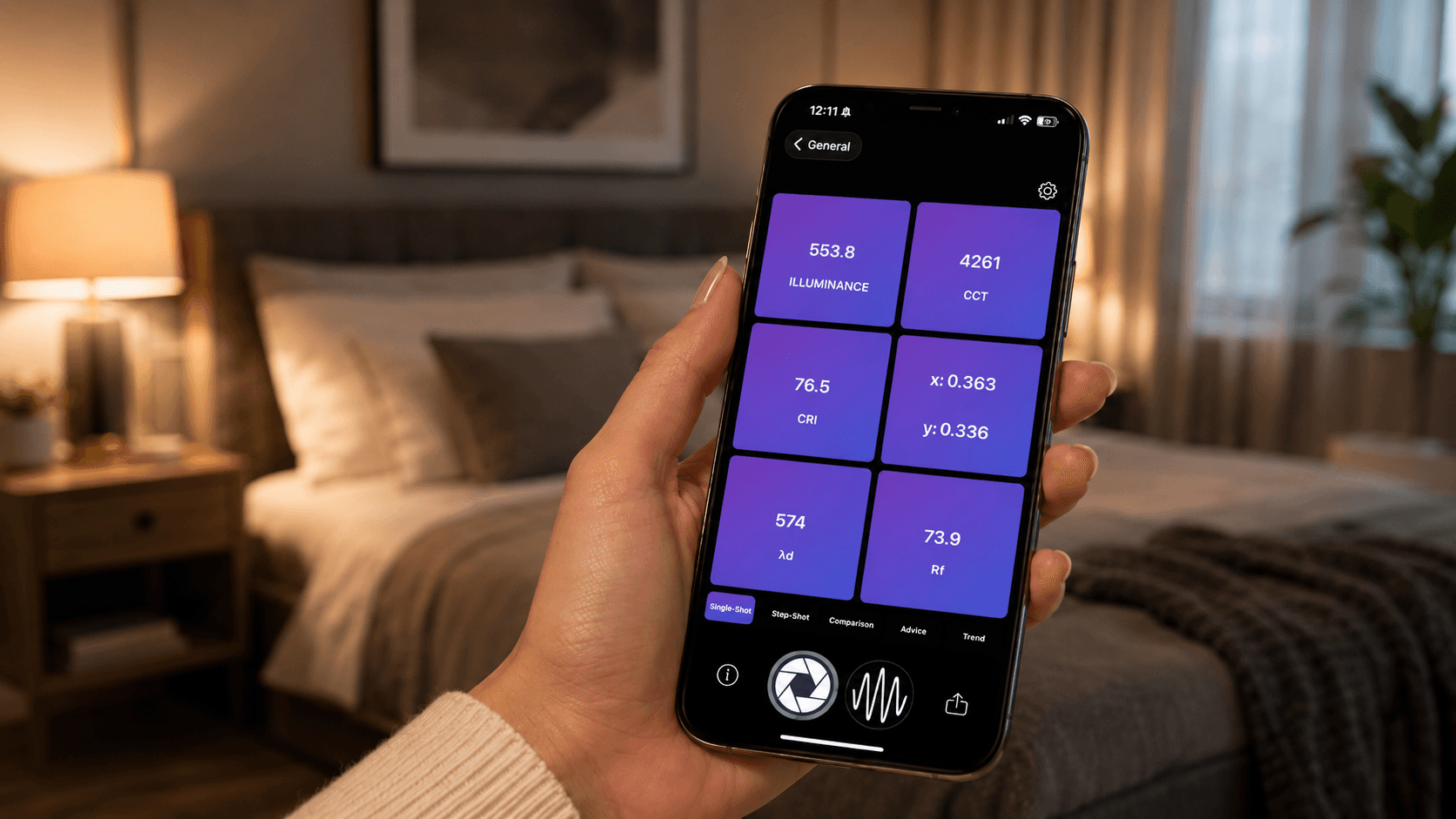
Colour temperature, the Kelvin figure printed on a bulb box, describes the appearance of a light on a scale from warm to cool. It does not describe the light's effect on your circadian clock. Two bulbs with the same colour temperature can send different signals to your body, because appearance and biological content are set by different features of the spectrum.
Almost every bulb you buy carries a number measured in kelvin: 2700K, 4000K, 6500K. It sits on the box next to the wattage and the lumens, and it is the figure most people use to decide whether a light is right for a bedroom or a kitchen. It is a genuinely useful number. It is also, for the question of sleep, close to silent.
The number describes colour temperature, and colour temperature describes how a light looks. Whether that light supports or disturbs your body clock is a different question, and the kelvin figure does not answer it. Understanding why is the quickest way to stop being misled by the box.
What is colour temperature, and what does the Kelvin number mean?
Colour temperature places a white light on a single scale from warm to cool, measured in kelvin. The scale comes from physics: heat a theoretical black body and it glows, first dull red, then amber, then white, then blue-white, as it gets hotter. A light's colour temperature is the point on that heated scale whose colour it most closely matches. Low numbers look warm. A candle sits near 1800 kelvin, a typical warm bulb near 2700. High numbers look cool. Overcast daylight sits near 6500 kelvin.
As a description of appearance, this is efficient and useful. It lets you coordinate the mood of a room and match one fitting to another. The trouble begins only when the number is asked to do a job it was never built for: predicting what a light does to your biology.

Why doesn't colour temperature tell you the circadian effect?
Colour temperature is a summary. It compresses the whole spectrum of a light, the full mix of wavelengths it emits, down to a single appearance coordinate. And a great deal of information is lost in that compression. Many different spectra can share the same colour temperature while being built from quite different ingredients. Two lights can both read as 2700K and yet contain noticeably different amounts of the short-wavelength content that the clock reads most strongly.
This is the same effect that undermines brightness as a guide. Two lights can look identical to the eye and still differ underneath, because the eye and the clock weight the spectrum differently. Colour temperature is tuned to appearance, which is set by the visual system. The circadian signal is set by a different receptor with a different sensitivity, peaking lower in the spectrum. So a light's kelvin figure and its biological effect are only loosely related. Lucas and colleagues (2014) made exactly this point in laying out how light should be measured: appearance-based descriptors are poor predictors of the melanopsin response, which is why a dedicated measure was needed.
Does a warmer bulb guarantee better sleep?
Not on its own, though it helps on average. As a loose rule, a warmer light at a given brightness tends to carry a lower circadian signal than a cool one, because shifting the appearance towards amber usually shifts the spectrum away from the short wavelengths the clock reads. If you had to choose blind, warmer is the better bet for the evening.
But a loose rule is not a measurement. Warm white produced by coating a blue emitter still contains short-wavelength energy beneath its golden appearance. Two warm bulbs with the same kelvin number can behave differently. And colour temperature interacts with brightness and distance, so the same warm bulb can be quiet or not depending on how bright it is and how close you sit. The kelvin figure captures none of that. It is a weak proxy standing in for a measurement, and it is right often enough to feel trustworthy and wrong often enough to matter.
How much does everyday indoor light matter?
It would matter less if we lived outdoors. We do not. One long-running national survey put the share of life spent indoors at close to ninety per cent (Klepeis and colleagues, 2001), which makes indoor light, and the numbers we use to choose it, the dominant signal most people's clocks receive. And the clock is sensitive at ordinary indoor levels, not only bright ones: Zeitzer and colleagues (2000) found roughly half the maximum effect on melatonin was reached near 100 lux. A room does not have to look bright, or look cool, to be sending a signal. The imprecision of colour temperature is therefore not a technicality. It plays out in the rooms where people spend their evenings.

What should you look at instead of colour temperature?
The reliable guide is the spectrum, weighted for the circadian system rather than for appearance. That is what the melanopic measure does. Melanopic equivalent daylight illuminance, or mEDI, defined in the international standard CIE S 026, expresses light in familiar lux units but through the melanopsin filter, so it reflects what the clock receives rather than what the eye sees.
With that measure in place, targets follow. A 2022 consensus of circadian scientists, led by Timothy Brown, recommends for healthy adults at least 250 melanopic lux at the eye during the day, no more than 10 in the evening, and no more than 1 while asleep. You cannot read any of those figures off a kelvin number. As with lux, there is no shortcut from the appearance descriptor to the biological one. To know the circadian load, you need the spectrum.
Colour temperature or melanopic EDI: which matters for sleep?
Both describe light, but they answer different questions. Colour temperature answers how a room will look and feel, warm or cool, cosy or crisp. Melanopic EDI answers what the light is doing to the system that decides when you feel tired. For mood and coordination, the kelvin number on the box is exactly the right tool. For sleep, it is the wrong one, and no amount of staring at it will make it the right one.
So the number on the box is not useless. It is answering a question about appearance, honestly and precisely. It simply is not answering the question about sleep, and it never was. Treat it as what it is, a guide to how a light looks, and look elsewhere for what a light does.
Frequently asked questions
Does colour temperature affect sleep?
Only indirectly. A warmer colour temperature often carries a lower circadian signal than a cool one at the same brightness, but colour temperature describes appearance and cannot tell you the actual effect on your clock.
Is 2700K light safe for the evening?
A 2700K bulb looks warm and is usually better than cool light in the evening, but the Kelvin figure does not measure circadian content, and warm sources vary. The reliable measure is melanopic EDI.
Can two bulbs with the same colour temperature differ for sleep?
Yes. Different spectra can share a colour temperature while delivering different amounts of the short-wavelength light the clock reads most strongly.
What should I look at instead of colour temperature?
Melanopic EDI, defined in CIE S 026, which weights light for the circadian system rather than for appearance. It is the measure that reflects what your clock receives.
References
1. Klepeis NE, Nelson WC, Ott WR, et al. The National Human Activity Pattern Survey (NHAPS): a resource for assessing exposure to environmental pollutants. Journal of Exposure Analysis and Environmental Epidemiology. 2001;11(3):231-252.
2. International Commission on Illumination. CIE 018:2019. The Basis of Physical Photometry. 3rd ed. Vienna: CIE; 2019.
3. al Enezi J, Revell V, Brown T, Wynne J, Schlangen L, Lucas R. A “melanopic” spectral efficiency function predicts the sensitivity of melanopsin photoreceptors to polychromatic light. Journal of Biological Rhythms. 2011;26(4):314-323.
4. Lucas RJ, Peirson SN, Berson DM, et al. Measuring and using light in the melanopsin age. Trends in Neurosciences. 2014;37(1):1-9.
5. Berson DM, Dunn FA, Takao M. Phototransduction by retinal ganglion cells that set the circadian clock. Science. 2002;295(5557):1070-1073.
6. Provencio I, Jiang G, De Grip WJ, et al. Melanopsin: an opsin in melanophores, brain, and eye. Proceedings of the National Academy of Sciences. 1998;95(1):340-345.
7. Zeitzer JM, Dijk DJ, Kronauer RE, Brown EN, Czeisler CA. Sensitivity of the human circadian pacemaker to nocturnal light: melatonin phase resetting and suppression. Journal of Physiology. 2000;526(3):695-702.
8. International Commission on Illumination. CIE S 026/E:2018. CIE System for Metrology of Optical Radiation for ipRGC-Influenced Responses to Light. Vienna: CIE; 2018.
9. Brown TM, Brainard GC, Cajochen C, et al. Recommendations for daytime, evening, and night-time indoor light exposure to best support physiology, sleep, and wakefulness in healthy adults. PLoS Biology. 2022;20(3):e3001571.
Roksana Fasovska
LONVIA Founder

Ready to shape a healthier future?
Book an introductory conversation to explore how well-being can be integrated into your space or project
Ready to shape a healthier future?
Book an introductory conversation to explore how well-being can be integrated into your space or project
Ready to shape a healthier future?
Book an introductory conversation to explore how well-being can be integrated into your space or project
8 min read
Key Insight
Colour temperature, the Kelvin figure printed on a bulb box, describes the appearance of a light on a scale from warm to cool. It does not describe the light's effect on your circadian clock. Two bulbs with the same colour temperature can send different signals to your body, because appearance and biological content are set by different features of the spectrum.
Colour temperature, the Kelvin figure printed on a bulb box, describes the appearance of a light on a scale from warm to cool. It does not describe the light's effect on your circadian clock. Two bulbs with the same colour temperature can send different signals to your body, because appearance and biological content are set by different features of the spectrum.
Almost every bulb you buy carries a number measured in kelvin: 2700K, 4000K, 6500K. It sits on the box next to the wattage and the lumens, and it is the figure most people use to decide whether a light is right for a bedroom or a kitchen. It is a genuinely useful number. It is also, for the question of sleep, close to silent.
The number describes colour temperature, and colour temperature describes how a light looks. Whether that light supports or disturbs your body clock is a different question, and the kelvin figure does not answer it. Understanding why is the quickest way to stop being misled by the box.
What is colour temperature, and what does the Kelvin number mean?
Colour temperature places a white light on a single scale from warm to cool, measured in kelvin. The scale comes from physics: heat a theoretical black body and it glows, first dull red, then amber, then white, then blue-white, as it gets hotter. A light's colour temperature is the point on that heated scale whose colour it most closely matches. Low numbers look warm. A candle sits near 1800 kelvin, a typical warm bulb near 2700. High numbers look cool. Overcast daylight sits near 6500 kelvin.
As a description of appearance, this is efficient and useful. It lets you coordinate the mood of a room and match one fitting to another. The trouble begins only when the number is asked to do a job it was never built for: predicting what a light does to your biology.
What is colour temperature, and what does the Kelvin number mean?
Colour temperature places a white light on a single scale from warm to cool, measured in kelvin. The scale comes from physics: heat a theoretical black body and it glows, first dull red, then amber, then white, then blue-white, as it gets hotter. A light's colour temperature is the point on that heated scale whose colour it most closely matches. Low numbers look warm. A candle sits near 1800 kelvin, a typical warm bulb near 2700. High numbers look cool. Overcast daylight sits near 6500 kelvin.
As a description of appearance, this is efficient and useful. It lets you coordinate the mood of a room and match one fitting to another. The trouble begins only when the number is asked to do a job it was never built for: predicting what a light does to your biology.
What is colour temperature, and what does the Kelvin number mean?
Colour temperature places a white light on a single scale from warm to cool, measured in kelvin. The scale comes from physics: heat a theoretical black body and it glows, first dull red, then amber, then white, then blue-white, as it gets hotter. A light's colour temperature is the point on that heated scale whose colour it most closely matches. Low numbers look warm. A candle sits near 1800 kelvin, a typical warm bulb near 2700. High numbers look cool. Overcast daylight sits near 6500 kelvin.
As a description of appearance, this is efficient and useful. It lets you coordinate the mood of a room and match one fitting to another. The trouble begins only when the number is asked to do a job it was never built for: predicting what a light does to your biology.
Almost every bulb you buy carries a number measured in kelvin: 2700K, 4000K, 6500K. It sits on the box next to the wattage and the lumens, and it is the figure most people use to decide whether a light is right for a bedroom or a kitchen. It is a genuinely useful number. It is also, for the question of sleep, close to silent.
The number describes colour temperature, and colour temperature describes how a light looks. Whether that light supports or disturbs your body clock is a different question, and the kelvin figure does not answer it. Understanding why is the quickest way to stop being misled by the box.
Why doesn't colour temperature tell you the circadian effect?
Colour temperature is a summary. It compresses the whole spectrum of a light, the full mix of wavelengths it emits, down to a single appearance coordinate. And a great deal of information is lost in that compression. Many different spectra can share the same colour temperature while being built from quite different ingredients. Two lights can both read as 2700K and yet contain noticeably different amounts of the short-wavelength content that the clock reads most strongly.
This is the same effect that undermines brightness as a guide. Two lights can look identical to the eye and still differ underneath, because the eye and the clock weight the spectrum differently. Colour temperature is tuned to appearance, which is set by the visual system. The circadian signal is set by a different receptor with a different sensitivity, peaking lower in the spectrum. So a light's kelvin figure and its biological effect are only loosely related. Lucas and colleagues (2014) made exactly this point in laying out how light should be measured: appearance-based descriptors are poor predictors of the melanopsin response, which is why a dedicated measure was needed.
Why doesn't colour temperature tell you the circadian effect?
Colour temperature is a summary. It compresses the whole spectrum of a light, the full mix of wavelengths it emits, down to a single appearance coordinate. And a great deal of information is lost in that compression. Many different spectra can share the same colour temperature while being built from quite different ingredients. Two lights can both read as 2700K and yet contain noticeably different amounts of the short-wavelength content that the clock reads most strongly.
This is the same effect that undermines brightness as a guide. Two lights can look identical to the eye and still differ underneath, because the eye and the clock weight the spectrum differently. Colour temperature is tuned to appearance, which is set by the visual system. The circadian signal is set by a different receptor with a different sensitivity, peaking lower in the spectrum. So a light's kelvin figure and its biological effect are only loosely related. Lucas and colleagues (2014) made exactly this point in laying out how light should be measured: appearance-based descriptors are poor predictors of the melanopsin response, which is why a dedicated measure was needed.
Does a warmer bulb guarantee better sleep?
Not on its own, though it helps on average. As a loose rule, a warmer light at a given brightness tends to carry a lower circadian signal than a cool one, because shifting the appearance towards amber usually shifts the spectrum away from the short wavelengths the clock reads. If you had to choose blind, warmer is the better bet for the evening.
But a loose rule is not a measurement. Warm white produced by coating a blue emitter still contains short-wavelength energy beneath its golden appearance. Two warm bulbs with the same kelvin number can behave differently. And colour temperature interacts with brightness and distance, so the same warm bulb can be quiet or not depending on how bright it is and how close you sit. The kelvin figure captures none of that. It is a weak proxy standing in for a measurement, and it is right often enough to feel trustworthy and wrong often enough to matter.
Does a warmer bulb guarantee better sleep?
Not on its own, though it helps on average. As a loose rule, a warmer light at a given brightness tends to carry a lower circadian signal than a cool one, because shifting the appearance towards amber usually shifts the spectrum away from the short wavelengths the clock reads. If you had to choose blind, warmer is the better bet for the evening.
But a loose rule is not a measurement. Warm white produced by coating a blue emitter still contains short-wavelength energy beneath its golden appearance. Two warm bulbs with the same kelvin number can behave differently. And colour temperature interacts with brightness and distance, so the same warm bulb can be quiet or not depending on how bright it is and how close you sit. The kelvin figure captures none of that. It is a weak proxy standing in for a measurement, and it is right often enough to feel trustworthy and wrong often enough to matter.
How much does everyday indoor light matter?
It would matter less if we lived outdoors. We do not. One long-running national survey put the share of life spent indoors at close to ninety per cent (Klepeis and colleagues, 2001), which makes indoor light, and the numbers we use to choose it, the dominant signal most people's clocks receive. And the clock is sensitive at ordinary indoor levels, not only bright ones: Zeitzer and colleagues (2000) found roughly half the maximum effect on melatonin was reached near 100 lux. A room does not have to look bright, or look cool, to be sending a signal. The imprecision of colour temperature is therefore not a technicality. It plays out in the rooms where people spend their evenings.
How much does everyday indoor light matter?
It would matter less if we lived outdoors. We do not. One long-running national survey put the share of life spent indoors at close to ninety per cent (Klepeis and colleagues, 2001), which makes indoor light, and the numbers we use to choose it, the dominant signal most people's clocks receive. And the clock is sensitive at ordinary indoor levels, not only bright ones: Zeitzer and colleagues (2000) found roughly half the maximum effect on melatonin was reached near 100 lux. A room does not have to look bright, or look cool, to be sending a signal. The imprecision of colour temperature is therefore not a technicality. It plays out in the rooms where people spend their evenings.
What should you look at instead of colour temperature?
The reliable guide is the spectrum, weighted for the circadian system rather than for appearance. That is what the melanopic measure does. Melanopic equivalent daylight illuminance, or mEDI, defined in the international standard CIE S 026, expresses light in familiar lux units but through the melanopsin filter, so it reflects what the clock receives rather than what the eye sees.
With that measure in place, targets follow. A 2022 consensus of circadian scientists, led by Timothy Brown, recommends for healthy adults at least 250 melanopic lux at the eye during the day, no more than 10 in the evening, and no more than 1 while asleep. You cannot read any of those figures off a kelvin number. As with lux, there is no shortcut from the appearance descriptor to the biological one. To know the circadian load, you need the spectrum.
What should you look at instead of colour temperature?
The reliable guide is the spectrum, weighted for the circadian system rather than for appearance. That is what the melanopic measure does. Melanopic equivalent daylight illuminance, or mEDI, defined in the international standard CIE S 026, expresses light in familiar lux units but through the melanopsin filter, so it reflects what the clock receives rather than what the eye sees.
With that measure in place, targets follow. A 2022 consensus of circadian scientists, led by Timothy Brown, recommends for healthy adults at least 250 melanopic lux at the eye during the day, no more than 10 in the evening, and no more than 1 while asleep. You cannot read any of those figures off a kelvin number. As with lux, there is no shortcut from the appearance descriptor to the biological one. To know the circadian load, you need the spectrum.
Colour temperature or melanopic EDI: which matters for sleep?
Both describe light, but they answer different questions. Colour temperature answers how a room will look and feel, warm or cool, cosy or crisp. Melanopic EDI answers what the light is doing to the system that decides when you feel tired. For mood and coordination, the kelvin number on the box is exactly the right tool. For sleep, it is the wrong one, and no amount of staring at it will make it the right one.
So the number on the box is not useless. It is answering a question about appearance, honestly and precisely. It simply is not answering the question about sleep, and it never was. Treat it as what it is, a guide to how a light looks, and look elsewhere for what a light does.
Colour temperature or melanopic EDI: which matters for sleep?
Both describe light, but they answer different questions. Colour temperature answers how a room will look and feel, warm or cool, cosy or crisp. Melanopic EDI answers what the light is doing to the system that decides when you feel tired. For mood and coordination, the kelvin number on the box is exactly the right tool. For sleep, it is the wrong one, and no amount of staring at it will make it the right one.
So the number on the box is not useless. It is answering a question about appearance, honestly and precisely. It simply is not answering the question about sleep, and it never was. Treat it as what it is, a guide to how a light looks, and look elsewhere for what a light does.
Frequently asked questions
Does colour temperature affect sleep?
Only indirectly. A warmer colour temperature often carries a lower circadian signal than a cool one at the same brightness, but colour temperature describes appearance and cannot tell you the actual effect on your clock.
Is 2700K light safe for the evening?
A 2700K bulb looks warm and is usually better than cool light in the evening, but the Kelvin figure does not measure circadian content, and warm sources vary. The reliable measure is melanopic EDI.
Can two bulbs with the same colour temperature differ for sleep?
Yes. Different spectra can share a colour temperature while delivering different amounts of the short-wavelength light the clock reads most strongly.
What should I look at instead of colour temperature?
Melanopic EDI, defined in CIE S 026, which weights light for the circadian system rather than for appearance. It is the measure that reflects what your clock receives.
References
1. Klepeis NE, Nelson WC, Ott WR, et al. The National Human Activity Pattern Survey (NHAPS): a resource for assessing exposure to environmental pollutants. Journal of Exposure Analysis and Environmental Epidemiology. 2001;11(3):231-252.
2. International Commission on Illumination. CIE 018:2019. The Basis of Physical Photometry. 3rd ed. Vienna: CIE; 2019.
3. al Enezi J, Revell V, Brown T, Wynne J, Schlangen L, Lucas R. A “melanopic” spectral efficiency function predicts the sensitivity of melanopsin photoreceptors to polychromatic light. Journal of Biological Rhythms. 2011;26(4):314-323.
4. Lucas RJ, Peirson SN, Berson DM, et al. Measuring and using light in the melanopsin age. Trends in Neurosciences. 2014;37(1):1-9.
5. Berson DM, Dunn FA, Takao M. Phototransduction by retinal ganglion cells that set the circadian clock. Science. 2002;295(5557):1070-1073.
6. Provencio I, Jiang G, De Grip WJ, et al. Melanopsin: an opsin in melanophores, brain, and eye. Proceedings of the National Academy of Sciences. 1998;95(1):340-345.
7. Zeitzer JM, Dijk DJ, Kronauer RE, Brown EN, Czeisler CA. Sensitivity of the human circadian pacemaker to nocturnal light: melatonin phase resetting and suppression. Journal of Physiology. 2000;526(3):695-702.
8. International Commission on Illumination. CIE S 026/E:2018. CIE System for Metrology of Optical Radiation for ipRGC-Influenced Responses to Light. Vienna: CIE; 2018.
9. Brown TM, Brainard GC, Cajochen C, et al. Recommendations for daytime, evening, and night-time indoor light exposure to best support physiology, sleep, and wakefulness in healthy adults. PLoS Biology. 2022;20(3):e3001571.
References
1. Klepeis NE, Nelson WC, Ott WR, et al. The National Human Activity Pattern Survey (NHAPS): a resource for assessing exposure to environmental pollutants. Journal of Exposure Analysis and Environmental Epidemiology. 2001;11(3):231-252.
2. International Commission on Illumination. CIE 018:2019. The Basis of Physical Photometry. 3rd ed. Vienna: CIE; 2019.
3. al Enezi J, Revell V, Brown T, Wynne J, Schlangen L, Lucas R. A “melanopic” spectral efficiency function predicts the sensitivity of melanopsin photoreceptors to polychromatic light. Journal of Biological Rhythms. 2011;26(4):314-323.
4. Lucas RJ, Peirson SN, Berson DM, et al. Measuring and using light in the melanopsin age. Trends in Neurosciences. 2014;37(1):1-9.
5. Berson DM, Dunn FA, Takao M. Phototransduction by retinal ganglion cells that set the circadian clock. Science. 2002;295(5557):1070-1073.
6. Provencio I, Jiang G, De Grip WJ, et al. Melanopsin: an opsin in melanophores, brain, and eye. Proceedings of the National Academy of Sciences. 1998;95(1):340-345.
7. Zeitzer JM, Dijk DJ, Kronauer RE, Brown EN, Czeisler CA. Sensitivity of the human circadian pacemaker to nocturnal light: melatonin phase resetting and suppression. Journal of Physiology. 2000;526(3):695-702.
8. International Commission on Illumination. CIE S 026/E:2018. CIE System for Metrology of Optical Radiation for ipRGC-Influenced Responses to Light. Vienna: CIE; 2018.
9. Brown TM, Brainard GC, Cajochen C, et al. Recommendations for daytime, evening, and night-time indoor light exposure to best support physiology, sleep, and wakefulness in healthy adults. PLoS Biology. 2022;20(3):e3001571.
Roksana Fasovska
Roksana Fasovska
LONVIA Founder
Circadian Science
Does colour temperature affect sleep? What Kelvin misses
8 min read
Colour temperature, the Kelvin figure printed on a bulb box, describes the appearance of a light on a scale from warm to cool. It does not describe the light's effect on your circadian clock. Two bulbs with the same colour temperature can send different signals to your body, because appearance and biological content are set by different features of the spectrum.
Key Insight
Almost every bulb you buy carries a number measured in kelvin: 2700K, 4000K, 6500K. It sits on the box next to the wattage and the lumens, and it is the figure most people use to decide whether a light is right for a bedroom or a kitchen. It is a genuinely useful number. It is also, for the question of sleep, close to silent.
The number describes colour temperature, and colour temperature describes how a light looks. Whether that light supports or disturbs your body clock is a different question, and the kelvin figure does not answer it. Understanding why is the quickest way to stop being misled by the box.
What is colour temperature, and what does the Kelvin number mean?
Colour temperature places a white light on a single scale from warm to cool, measured in kelvin. The scale comes from physics: heat a theoretical black body and it glows, first dull red, then amber, then white, then blue-white, as it gets hotter. A light's colour temperature is the point on that heated scale whose colour it most closely matches. Low numbers look warm. A candle sits near 1800 kelvin, a typical warm bulb near 2700. High numbers look cool. Overcast daylight sits near 6500 kelvin.
As a description of appearance, this is efficient and useful. It lets you coordinate the mood of a room and match one fitting to another. The trouble begins only when the number is asked to do a job it was never built for: predicting what a light does to your biology.
What is colour temperature, and what does the Kelvin number mean?
Colour temperature places a white light on a single scale from warm to cool, measured in kelvin. The scale comes from physics: heat a theoretical black body and it glows, first dull red, then amber, then white, then blue-white, as it gets hotter. A light's colour temperature is the point on that heated scale whose colour it most closely matches. Low numbers look warm. A candle sits near 1800 kelvin, a typical warm bulb near 2700. High numbers look cool. Overcast daylight sits near 6500 kelvin.
As a description of appearance, this is efficient and useful. It lets you coordinate the mood of a room and match one fitting to another. The trouble begins only when the number is asked to do a job it was never built for: predicting what a light does to your biology.
What is colour temperature, and what does the Kelvin number mean?
Colour temperature places a white light on a single scale from warm to cool, measured in kelvin. The scale comes from physics: heat a theoretical black body and it glows, first dull red, then amber, then white, then blue-white, as it gets hotter. A light's colour temperature is the point on that heated scale whose colour it most closely matches. Low numbers look warm. A candle sits near 1800 kelvin, a typical warm bulb near 2700. High numbers look cool. Overcast daylight sits near 6500 kelvin.
As a description of appearance, this is efficient and useful. It lets you coordinate the mood of a room and match one fitting to another. The trouble begins only when the number is asked to do a job it was never built for: predicting what a light does to your biology.
Almost every bulb you buy carries a number measured in kelvin: 2700K, 4000K, 6500K. It sits on the box next to the wattage and the lumens, and it is the figure most people use to decide whether a light is right for a bedroom or a kitchen. It is a genuinely useful number. It is also, for the question of sleep, close to silent.
The number describes colour temperature, and colour temperature describes how a light looks. Whether that light supports or disturbs your body clock is a different question, and the kelvin figure does not answer it. Understanding why is the quickest way to stop being misled by the box.
Why doesn't colour temperature tell you the circadian effect?
Colour temperature is a summary. It compresses the whole spectrum of a light, the full mix of wavelengths it emits, down to a single appearance coordinate. And a great deal of information is lost in that compression. Many different spectra can share the same colour temperature while being built from quite different ingredients. Two lights can both read as 2700K and yet contain noticeably different amounts of the short-wavelength content that the clock reads most strongly.
This is the same effect that undermines brightness as a guide. Two lights can look identical to the eye and still differ underneath, because the eye and the clock weight the spectrum differently. Colour temperature is tuned to appearance, which is set by the visual system. The circadian signal is set by a different receptor with a different sensitivity, peaking lower in the spectrum. So a light's kelvin figure and its biological effect are only loosely related. Lucas and colleagues (2014) made exactly this point in laying out how light should be measured: appearance-based descriptors are poor predictors of the melanopsin response, which is why a dedicated measure was needed.
Why doesn't colour temperature tell you the circadian effect?
Colour temperature is a summary. It compresses the whole spectrum of a light, the full mix of wavelengths it emits, down to a single appearance coordinate. And a great deal of information is lost in that compression. Many different spectra can share the same colour temperature while being built from quite different ingredients. Two lights can both read as 2700K and yet contain noticeably different amounts of the short-wavelength content that the clock reads most strongly.
This is the same effect that undermines brightness as a guide. Two lights can look identical to the eye and still differ underneath, because the eye and the clock weight the spectrum differently. Colour temperature is tuned to appearance, which is set by the visual system. The circadian signal is set by a different receptor with a different sensitivity, peaking lower in the spectrum. So a light's kelvin figure and its biological effect are only loosely related. Lucas and colleagues (2014) made exactly this point in laying out how light should be measured: appearance-based descriptors are poor predictors of the melanopsin response, which is why a dedicated measure was needed.
Does a warmer bulb guarantee better sleep?
Not on its own, though it helps on average. As a loose rule, a warmer light at a given brightness tends to carry a lower circadian signal than a cool one, because shifting the appearance towards amber usually shifts the spectrum away from the short wavelengths the clock reads. If you had to choose blind, warmer is the better bet for the evening.
But a loose rule is not a measurement. Warm white produced by coating a blue emitter still contains short-wavelength energy beneath its golden appearance. Two warm bulbs with the same kelvin number can behave differently. And colour temperature interacts with brightness and distance, so the same warm bulb can be quiet or not depending on how bright it is and how close you sit. The kelvin figure captures none of that. It is a weak proxy standing in for a measurement, and it is right often enough to feel trustworthy and wrong often enough to matter.
Does a warmer bulb guarantee better sleep?
Not on its own, though it helps on average. As a loose rule, a warmer light at a given brightness tends to carry a lower circadian signal than a cool one, because shifting the appearance towards amber usually shifts the spectrum away from the short wavelengths the clock reads. If you had to choose blind, warmer is the better bet for the evening.
But a loose rule is not a measurement. Warm white produced by coating a blue emitter still contains short-wavelength energy beneath its golden appearance. Two warm bulbs with the same kelvin number can behave differently. And colour temperature interacts with brightness and distance, so the same warm bulb can be quiet or not depending on how bright it is and how close you sit. The kelvin figure captures none of that. It is a weak proxy standing in for a measurement, and it is right often enough to feel trustworthy and wrong often enough to matter.
How much does everyday indoor light matter?
It would matter less if we lived outdoors. We do not. One long-running national survey put the share of life spent indoors at close to ninety per cent (Klepeis and colleagues, 2001), which makes indoor light, and the numbers we use to choose it, the dominant signal most people's clocks receive. And the clock is sensitive at ordinary indoor levels, not only bright ones: Zeitzer and colleagues (2000) found roughly half the maximum effect on melatonin was reached near 100 lux. A room does not have to look bright, or look cool, to be sending a signal. The imprecision of colour temperature is therefore not a technicality. It plays out in the rooms where people spend their evenings.
How much does everyday indoor light matter?
It would matter less if we lived outdoors. We do not. One long-running national survey put the share of life spent indoors at close to ninety per cent (Klepeis and colleagues, 2001), which makes indoor light, and the numbers we use to choose it, the dominant signal most people's clocks receive. And the clock is sensitive at ordinary indoor levels, not only bright ones: Zeitzer and colleagues (2000) found roughly half the maximum effect on melatonin was reached near 100 lux. A room does not have to look bright, or look cool, to be sending a signal. The imprecision of colour temperature is therefore not a technicality. It plays out in the rooms where people spend their evenings.
What should you look at instead of colour temperature?
The reliable guide is the spectrum, weighted for the circadian system rather than for appearance. That is what the melanopic measure does. Melanopic equivalent daylight illuminance, or mEDI, defined in the international standard CIE S 026, expresses light in familiar lux units but through the melanopsin filter, so it reflects what the clock receives rather than what the eye sees.
With that measure in place, targets follow. A 2022 consensus of circadian scientists, led by Timothy Brown, recommends for healthy adults at least 250 melanopic lux at the eye during the day, no more than 10 in the evening, and no more than 1 while asleep. You cannot read any of those figures off a kelvin number. As with lux, there is no shortcut from the appearance descriptor to the biological one. To know the circadian load, you need the spectrum.
What should you look at instead of colour temperature?
The reliable guide is the spectrum, weighted for the circadian system rather than for appearance. That is what the melanopic measure does. Melanopic equivalent daylight illuminance, or mEDI, defined in the international standard CIE S 026, expresses light in familiar lux units but through the melanopsin filter, so it reflects what the clock receives rather than what the eye sees.
With that measure in place, targets follow. A 2022 consensus of circadian scientists, led by Timothy Brown, recommends for healthy adults at least 250 melanopic lux at the eye during the day, no more than 10 in the evening, and no more than 1 while asleep. You cannot read any of those figures off a kelvin number. As with lux, there is no shortcut from the appearance descriptor to the biological one. To know the circadian load, you need the spectrum.
Colour temperature or melanopic EDI: which matters for sleep?
Both describe light, but they answer different questions. Colour temperature answers how a room will look and feel, warm or cool, cosy or crisp. Melanopic EDI answers what the light is doing to the system that decides when you feel tired. For mood and coordination, the kelvin number on the box is exactly the right tool. For sleep, it is the wrong one, and no amount of staring at it will make it the right one.
So the number on the box is not useless. It is answering a question about appearance, honestly and precisely. It simply is not answering the question about sleep, and it never was. Treat it as what it is, a guide to how a light looks, and look elsewhere for what a light does.
Colour temperature or melanopic EDI: which matters for sleep?
Both describe light, but they answer different questions. Colour temperature answers how a room will look and feel, warm or cool, cosy or crisp. Melanopic EDI answers what the light is doing to the system that decides when you feel tired. For mood and coordination, the kelvin number on the box is exactly the right tool. For sleep, it is the wrong one, and no amount of staring at it will make it the right one.
So the number on the box is not useless. It is answering a question about appearance, honestly and precisely. It simply is not answering the question about sleep, and it never was. Treat it as what it is, a guide to how a light looks, and look elsewhere for what a light does.
Frequently asked questions
Does colour temperature affect sleep?
Only indirectly. A warmer colour temperature often carries a lower circadian signal than a cool one at the same brightness, but colour temperature describes appearance and cannot tell you the actual effect on your clock.
Is 2700K light safe for the evening?
A 2700K bulb looks warm and is usually better than cool light in the evening, but the Kelvin figure does not measure circadian content, and warm sources vary. The reliable measure is melanopic EDI.
Can two bulbs with the same colour temperature differ for sleep?
Yes. Different spectra can share a colour temperature while delivering different amounts of the short-wavelength light the clock reads most strongly.
What should I look at instead of colour temperature?
Melanopic EDI, defined in CIE S 026, which weights light for the circadian system rather than for appearance. It is the measure that reflects what your clock receives.
References
1. Klepeis NE, Nelson WC, Ott WR, et al. The National Human Activity Pattern Survey (NHAPS): a resource for assessing exposure to environmental pollutants. Journal of Exposure Analysis and Environmental Epidemiology. 2001;11(3):231-252.
2. International Commission on Illumination. CIE 018:2019. The Basis of Physical Photometry. 3rd ed. Vienna: CIE; 2019.
3. al Enezi J, Revell V, Brown T, Wynne J, Schlangen L, Lucas R. A “melanopic” spectral efficiency function predicts the sensitivity of melanopsin photoreceptors to polychromatic light. Journal of Biological Rhythms. 2011;26(4):314-323.
4. Lucas RJ, Peirson SN, Berson DM, et al. Measuring and using light in the melanopsin age. Trends in Neurosciences. 2014;37(1):1-9.
5. Berson DM, Dunn FA, Takao M. Phototransduction by retinal ganglion cells that set the circadian clock. Science. 2002;295(5557):1070-1073.
6. Provencio I, Jiang G, De Grip WJ, et al. Melanopsin: an opsin in melanophores, brain, and eye. Proceedings of the National Academy of Sciences. 1998;95(1):340-345.
7. Zeitzer JM, Dijk DJ, Kronauer RE, Brown EN, Czeisler CA. Sensitivity of the human circadian pacemaker to nocturnal light: melatonin phase resetting and suppression. Journal of Physiology. 2000;526(3):695-702.
8. International Commission on Illumination. CIE S 026/E:2018. CIE System for Metrology of Optical Radiation for ipRGC-Influenced Responses to Light. Vienna: CIE; 2018.
9. Brown TM, Brainard GC, Cajochen C, et al. Recommendations for daytime, evening, and night-time indoor light exposure to best support physiology, sleep, and wakefulness in healthy adults. PLoS Biology. 2022;20(3):e3001571.
References
1. Klepeis NE, Nelson WC, Ott WR, et al. The National Human Activity Pattern Survey (NHAPS): a resource for assessing exposure to environmental pollutants. Journal of Exposure Analysis and Environmental Epidemiology. 2001;11(3):231-252.
2. International Commission on Illumination. CIE 018:2019. The Basis of Physical Photometry. 3rd ed. Vienna: CIE; 2019.
3. al Enezi J, Revell V, Brown T, Wynne J, Schlangen L, Lucas R. A “melanopic” spectral efficiency function predicts the sensitivity of melanopsin photoreceptors to polychromatic light. Journal of Biological Rhythms. 2011;26(4):314-323.
4. Lucas RJ, Peirson SN, Berson DM, et al. Measuring and using light in the melanopsin age. Trends in Neurosciences. 2014;37(1):1-9.
5. Berson DM, Dunn FA, Takao M. Phototransduction by retinal ganglion cells that set the circadian clock. Science. 2002;295(5557):1070-1073.
6. Provencio I, Jiang G, De Grip WJ, et al. Melanopsin: an opsin in melanophores, brain, and eye. Proceedings of the National Academy of Sciences. 1998;95(1):340-345.
7. Zeitzer JM, Dijk DJ, Kronauer RE, Brown EN, Czeisler CA. Sensitivity of the human circadian pacemaker to nocturnal light: melatonin phase resetting and suppression. Journal of Physiology. 2000;526(3):695-702.
8. International Commission on Illumination. CIE S 026/E:2018. CIE System for Metrology of Optical Radiation for ipRGC-Influenced Responses to Light. Vienna: CIE; 2018.
9. Brown TM, Brainard GC, Cajochen C, et al. Recommendations for daytime, evening, and night-time indoor light exposure to best support physiology, sleep, and wakefulness in healthy adults. PLoS Biology. 2022;20(3):e3001571.
Roksana Fasovska
LONVIA Founder