The LONVIA Edit
Curated insights on space, health, investment, and the future of living.
Circadian Science
Lux vs. Melanopic Lux: Why Lux does not measure biology
The LONVIA
Edit
Curated insights on space, health, investment, and the future of living.
Circadian Science
Lux vs. Melanopic Lux: Why Lux does not measure biology
9 min read
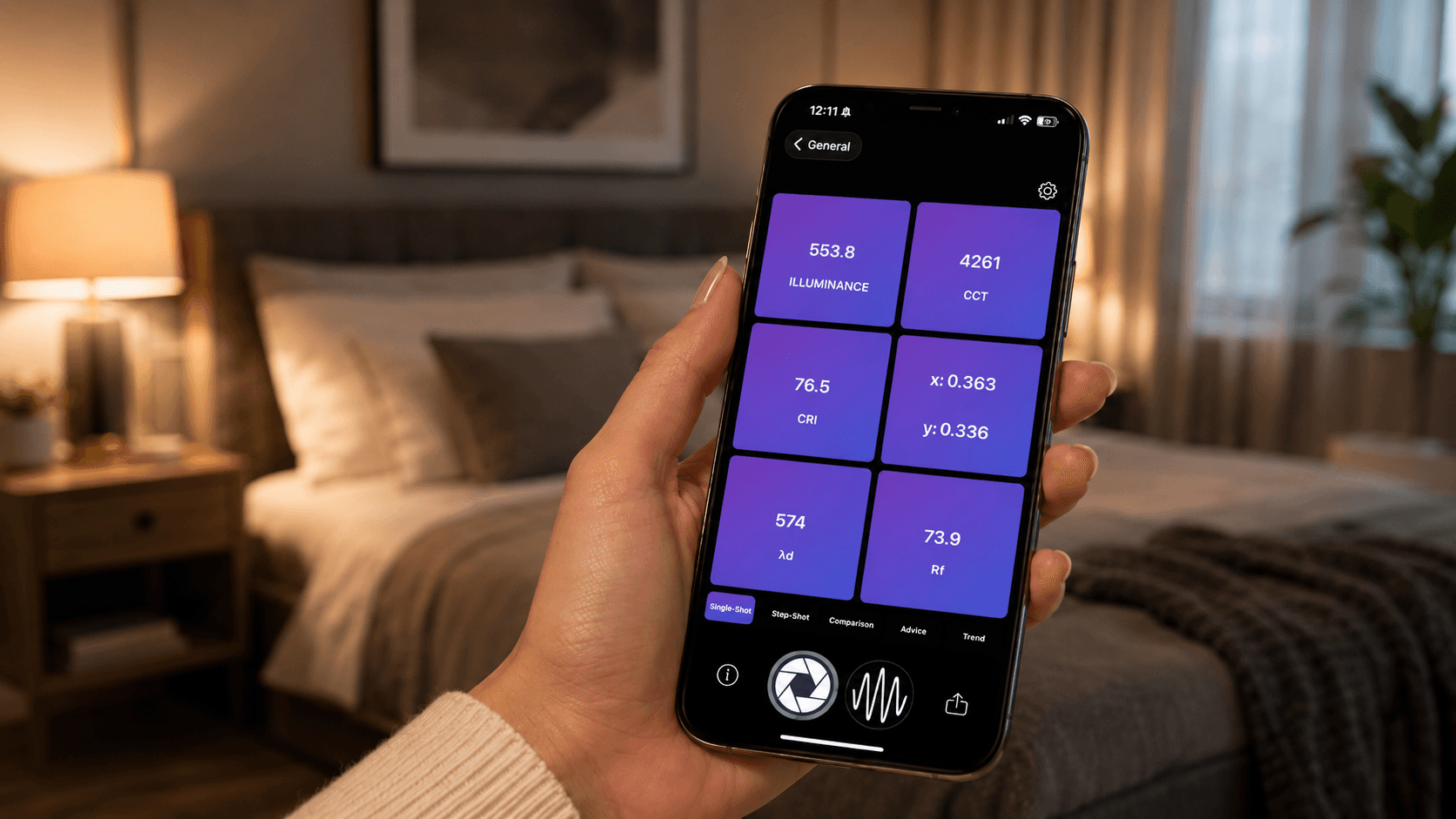
Lux measures brightness as the human eye perceives it in daylight. It does not capture the biological effect of light on your circadian clock, because the clock runs on a different photoreceptor with a different spectral sensitivity. Two lights can share the same lux while sending very different signals to your body. The measure that reflects that effect is melanopic EDI, defined in the international standard CIE S 026.
The most common number in lighting was built to describe what your eyes see. It was never meant to describe what your clock receives, and it cannot.
You can buy a light meter for the price of lunch, or use the one already built into your phone. Point it at a room and it returns a number in lux. That number is real. It is standardised across the world, it has specified offices and streets and operating theatres for a century, and it does its job well. It is also blind to the one thing you most want to know about your light in the evening.
This matters because indoor light is the light that governs most of us. People in industrialised countries spend the large majority of their lives inside. One long-running national survey put it at close to ninety per cent of the day (Klepeis and colleagues, 2001). The signal your clock reads is therefore set less by the open sky than by the rooms you sit in, and by the number we use to describe them.
The gap between what lux measures and what your body responds to is not a rounding error. It is the central confusion in how we think about light, and it is worth understanding exactly where it comes from.
What is lux, and what does it actually measure?
Lux is a measure of illuminance: how much light falls on a surface. It is defined as lumens per square metre. The important word is lumens, because a lumen is not a raw measure of energy. It is radiant power that has been weighted by a curve called the photopic luminous efficiency function, adopted by the international lighting body in 1924 and still in use today. That curve, written V(lambda), describes how sensitive the average human eye is to each wavelength of light for daytime vision. It peaks in the green-yellow, near 555 nanometres, and falls away towards the red and blue ends of the spectrum.
The curve does not describe your eye in particular. It describes a standard observer, an average built from many people, which is exactly what makes it useful as a shared unit. So when a meter reports lux, it is not reporting how much light is present in some neutral sense. It is reporting how bright that light looks to a typical human eye in daytime conditions. Built into the number, before you ever read it, is a model of human vision. This is not a flaw. It is the entire point, and it is why lux is such a good tool for the job it was built for: telling you whether a space is bright enough to see and work in comfortably.
What information does a lux reading leave out?
To turn a whole spectrum of light into a single brightness figure, lux has to discard almost everything about that spectrum. It keeps one thing, perceived brightness, and lets the rest go.
The consequence is that two completely different lights can produce an identical lux reading. A warmer source and a cooler source, adjusted so they look equally bright, will read the same on the meter, even though their spectra, the actual mix of wavelengths they emit, are nothing alike.
Physicists have a name for this. Two lights with different spectra that look identical are called metamers, and the effect is called metamerism. The visual system cannot tell metamers apart, which is convenient when designing screens or matching paint, where matching appearance is the whole goal. But the non-visual system in your eye, the one described in the previous article, is not fooled in the same way, because it reads the spectrum through a different filter. Its peak sensitivity sits much lower, near 480 nanometres, in the blue region that the visual curve treats as relatively unimportant. A pair of lights that are indistinguishable to your sight can carry quite different weight to your clock. The match that satisfies your eyes says nothing about the match that would matter to your rhythm.
A plainer comparison helps. Lux is a little like judging a meal by its total weight. Weight is real, easy to measure, and genuinely useful for some purposes. But two plates can weigh exactly the same and be nutritionally opposite. If what you care about is nutrition, the number on the kitchen scale is the wrong one. It is not false. It is answering a different question.
How much light does it take to affect the clock?
It is tempting to assume that only bright light counts, and that a dim room is automatically safe. The evidence does not support that. In controlled laboratory work, Zeitzer and colleagues (2000) showed that the human circadian pacemaker responds to light across the range found in ordinary rooms, with roughly half of the maximum effect on melatonin reached near 100 lux and much of the response saturating not far above it. Everyday indoor light sits squarely inside the range the clock can read. A room does not have to look bright to be sending a signal, which is precisely why judging it by appearance is unreliable.
Why isn't warm and dim enough in the evening?
The standard advice for evenings is to make the light warm and dim, and both instincts point in a helpful direction. But neither one guarantees a low signal to the clock, because brightness and biological load are not locked together.
Dimming reduces lux. Whether it reduces the melanopic signal by the same amount depends on the spectrum, which dimming often leaves unchanged. Warmth shifts the spectrum, but warm is a description of appearance, not a measurement of circadian content, and warm sources vary widely in what they actually deliver to the non-visual system. You can hold perceived brightness steady while cutting the circadian load, or reduce brightness while leaving the load higher than you would expect. The meter on your phone cannot tell you which is happening, because it is measuring brightness, honestly and precisely, and brightness is not the quantity in question.
How do you measure the light your clock receives?
To know what your circadian system is receiving, you have to measure the spectrum and weight it by the melanopsin sensitivity curve rather than by V(lambda). Same light, different filter.
A weighting curve of this kind is called an action spectrum. It maps how effective each wavelength is at driving a particular biological response. V(lambda) is the action spectrum for daytime vision. The melanopic curve is the action spectrum for the melanopsin system. They are different shapes because they belong to different receptors doing different jobs, and that difference in shape is the whole reason one number cannot stand in for the other.
This is what the international standard CIE S 026 set out in 2018. From a single spectral measurement of a light source you can calculate two numbers. One uses the visual weighting and gives you lux, for what you see. The other uses the melanopic weighting and gives you melanopic equivalent daylight illuminance, or mEDI, for what your clock receives. The light is the same. The question you ask of it is different, so the answer is different.
With that weighting in place, it becomes possible to state targets. A 2022 consensus of circadian scientists, led by Timothy Brown, recommends for healthy adults at least 250 melanopic lux at the eye during the day, no more than 10 in the evening, and no more than 1 while asleep. Those figures describe what the non-visual system wants across a day, and not one of them can be read off a lux meter.
One further point is easy to miss. You cannot get mEDI from lux. A lux reading alone does not contain the spectral information the melanopic calculation needs. Neither does a colour temperature label, which is a related shorthand worth its own discussion. To know the circadian load, you need the spectrum. There is no shortcut from the brightness number to the biological one.

What does this mean for choosing and checking light at home?
Two practical conclusions come out of this, and both cut against common habits. The first is that a lux app cannot tell you about your evening light exposure in the sense that matters. It will give you an honest brightness reading and no information at all about circadian load. The second is that a specification sheet listing lumens and lux is describing visibility, not biology. Those figures are appropriate and necessary for their purpose. They simply do not answer the question of what a light does to your rhythm.
There is an honest reason the category leans so heavily on lux and its cousin, colour temperature. They are easy. A lux meter is cheap, and a colour temperature is a single friendly number on a box. Spectral measurement, the thing you would actually need, is more involved. But easy and correct are not the same, and the fact that the right measurement is harder does not make the easy one right.
Lux or melanopic lux: which should you use?
None of this makes lux a bad unit. It is the correct tool for the question it was designed to answer: how bright does this space look. The mistake is not in the meter. It is in using a measure of appearance as a stand-in for a measure of biological effect, when the two come apart as soon as the spectrum changes.
Lux measures how a room looks to your eyes. That is worth knowing. How a room reads to the system that governs your sleep is a separate question, and it needs a separate measurement. Confusing the two is the most common error in how we talk about light. Keeping them apart is where a serious approach begins.
With light,
Roksana Fasovska
LONVIA Founder
Frequently asked questions
What is the difference between lux and melanopic lux?
Lux measures light as the human eye perceives brightness in daylight. Melanopic lux, or melanopic EDI, measures the same light weighted for the receptor that sets the circadian clock. Two lights can share a lux value and still differ in melanopic lux.
Can a phone app measure my circadian light exposure?
A phone lux app gives an honest brightness reading, but it cannot tell you the melanopic dose, which depends on the light's spectrum. For circadian purposes it is measuring the wrong quantity.
Does a lower colour temperature mean a light is safe for the evening?
Not on its own. Warmer light usually helps, but colour temperature describes appearance, not circadian content, and warm sources vary in what they deliver to the clock. The reliable measure is melanopic EDI.
What is melanopic EDI (mEDI)?
Melanopic equivalent daylight illuminance is light measured through the melanopsin sensitivity curve rather than the visual one, expressed in lux for comparison. It is defined in the international standard CIE S 026 and estimates what your circadian system receives.
References
Klepeis NE, Nelson WC, Ott WR, et al. The National Human Activity Pattern Survey (NHAPS): a resource for assessing exposure to environmental pollutants. Journal of Exposure Analysis and Environmental Epidemiology. 2001;11(3):231-252.
International Commission on Illumination. CIE 018:2019. The Basis of Physical Photometry. 3rd ed. Vienna: CIE; 2019.
al Enezi J, Revell V, Brown T, Wynne J, Schlangen L, Lucas R. A “melanopic” spectral efficiency function predicts the sensitivity of melanopsin photoreceptors to polychromatic light. Journal of Biological Rhythms. 2011;26(4):314-323.
Lucas RJ, Peirson SN, Berson DM, et al. Measuring and using light in the melanopsin age. Trends in Neurosciences. 2014;37(1):1-9.
International Commission on Illumination. CIE S 026/E:2018. CIE System for Metrology of Optical Radiation for ipRGC-Influenced Responses to Light. Vienna: CIE; 2018.
Berson DM, Dunn FA, Takao M. Phototransduction by retinal ganglion cells that set the circadian clock. Science. 2002;295(5557):1070-1073.
Gooley JJ, Rajaratnam SMW, Brainard GC, et al. Spectral responses of the human circadian system depend on the irradiance and duration of exposure to light. Science Translational Medicine. 2010;2(31):31ra33.
Zeitzer JM, Dijk DJ, Kronauer RE, Brown EN, Czeisler CA. Sensitivity of the human circadian pacemaker to nocturnal light: melatonin phase resetting and suppression. Journal of Physiology. 2000;526(3):695-702.
Brown TM, Brainard GC, Cajochen C, et al. Recommendations for daytime, evening, and night-time indoor light exposure to best support physiology, sleep, and wakefulness in healthy adults. PLoS Biology. 2022;20(3):e3001571.

Ready to shape a healthier future?
Book an introductory conversation to explore how well-being can be integrated into your space or project
Ready to shape a healthier future?
Book an introductory conversation to explore how well-being can be integrated into your space or project
Ready to shape a healthier future?
Book an introductory conversation to explore how well-being can be integrated into your space or project
9 min read
Key Insight
Lux measures brightness as the human eye perceives it in daylight. It does not capture the biological effect of light on your circadian clock, because the clock runs on a different photoreceptor with a different spectral sensitivity. Two lights can share the same lux while sending very different signals to your body. The measure that reflects that effect is melanopic EDI, defined in the international standard CIE S 026.
Lux measures brightness as the human eye perceives it in daylight. It does not capture the biological effect of light on your circadian clock, because the clock runs on a different photoreceptor with a different spectral sensitivity. Two lights can share the same lux while sending very different signals to your body. The measure that reflects that effect is melanopic EDI, defined in the international standard CIE S 026.
The most common number in lighting was built to describe what your eyes see. It was never meant to describe what your clock receives, and it cannot.
You can buy a light meter for the price of lunch, or use the one already built into your phone. Point it at a room and it returns a number in lux. That number is real. It is standardised across the world, it has specified offices and streets and operating theatres for a century, and it does its job well. It is also blind to the one thing you most want to know about your light in the evening.
This matters because indoor light is the light that governs most of us. People in industrialised countries spend the large majority of their lives inside. One long-running national survey put it at close to ninety per cent of the day (Klepeis and colleagues, 2001). The signal your clock reads is therefore set less by the open sky than by the rooms you sit in, and by the number we use to describe them.
The gap between what lux measures and what your body responds to is not a rounding error. It is the central confusion in how we think about light, and it is worth understanding exactly where it comes from.
What is lux, and what does it actually measure?
Lux is a measure of illuminance: how much light falls on a surface. It is defined as lumens per square metre. The important word is lumens, because a lumen is not a raw measure of energy. It is radiant power that has been weighted by a curve called the photopic luminous efficiency function, adopted by the international lighting body in 1924 and still in use today. That curve, written V(lambda), describes how sensitive the average human eye is to each wavelength of light for daytime vision. It peaks in the green-yellow, near 555 nanometres, and falls away towards the red and blue ends of the spectrum.
The curve does not describe your eye in particular. It describes a standard observer, an average built from many people, which is exactly what makes it useful as a shared unit. So when a meter reports lux, it is not reporting how much light is present in some neutral sense. It is reporting how bright that light looks to a typical human eye in daytime conditions. Built into the number, before you ever read it, is a model of human vision. This is not a flaw. It is the entire point, and it is why lux is such a good tool for the job it was built for: telling you whether a space is bright enough to see and work in comfortably.
What is lux, and what does it actually measure?
Lux is a measure of illuminance: how much light falls on a surface. It is defined as lumens per square metre. The important word is lumens, because a lumen is not a raw measure of energy. It is radiant power that has been weighted by a curve called the photopic luminous efficiency function, adopted by the international lighting body in 1924 and still in use today. That curve, written V(lambda), describes how sensitive the average human eye is to each wavelength of light for daytime vision. It peaks in the green-yellow, near 555 nanometres, and falls away towards the red and blue ends of the spectrum.
The curve does not describe your eye in particular. It describes a standard observer, an average built from many people, which is exactly what makes it useful as a shared unit. So when a meter reports lux, it is not reporting how much light is present in some neutral sense. It is reporting how bright that light looks to a typical human eye in daytime conditions. Built into the number, before you ever read it, is a model of human vision. This is not a flaw. It is the entire point, and it is why lux is such a good tool for the job it was built for: telling you whether a space is bright enough to see and work in comfortably.
What is lux, and what does it actually measure?
Lux is a measure of illuminance: how much light falls on a surface. It is defined as lumens per square metre. The important word is lumens, because a lumen is not a raw measure of energy. It is radiant power that has been weighted by a curve called the photopic luminous efficiency function, adopted by the international lighting body in 1924 and still in use today. That curve, written V(lambda), describes how sensitive the average human eye is to each wavelength of light for daytime vision. It peaks in the green-yellow, near 555 nanometres, and falls away towards the red and blue ends of the spectrum.
The curve does not describe your eye in particular. It describes a standard observer, an average built from many people, which is exactly what makes it useful as a shared unit. So when a meter reports lux, it is not reporting how much light is present in some neutral sense. It is reporting how bright that light looks to a typical human eye in daytime conditions. Built into the number, before you ever read it, is a model of human vision. This is not a flaw. It is the entire point, and it is why lux is such a good tool for the job it was built for: telling you whether a space is bright enough to see and work in comfortably.
The most common number in lighting was built to describe what your eyes see. It was never meant to describe what your clock receives, and it cannot.
You can buy a light meter for the price of lunch, or use the one already built into your phone. Point it at a room and it returns a number in lux. That number is real. It is standardised across the world, it has specified offices and streets and operating theatres for a century, and it does its job well. It is also blind to the one thing you most want to know about your light in the evening.
This matters because indoor light is the light that governs most of us. People in industrialised countries spend the large majority of their lives inside. One long-running national survey put it at close to ninety per cent of the day (Klepeis and colleagues, 2001). The signal your clock reads is therefore set less by the open sky than by the rooms you sit in, and by the number we use to describe them.
The gap between what lux measures and what your body responds to is not a rounding error. It is the central confusion in how we think about light, and it is worth understanding exactly where it comes from.
What information does a lux reading leave out?
To turn a whole spectrum of light into a single brightness figure, lux has to discard almost everything about that spectrum. It keeps one thing, perceived brightness, and lets the rest go.
The consequence is that two completely different lights can produce an identical lux reading. A warmer source and a cooler source, adjusted so they look equally bright, will read the same on the meter, even though their spectra, the actual mix of wavelengths they emit, are nothing alike.
Physicists have a name for this. Two lights with different spectra that look identical are called metamers, and the effect is called metamerism. The visual system cannot tell metamers apart, which is convenient when designing screens or matching paint, where matching appearance is the whole goal. But the non-visual system in your eye, the one described in the previous article, is not fooled in the same way, because it reads the spectrum through a different filter. Its peak sensitivity sits much lower, near 480 nanometres, in the blue region that the visual curve treats as relatively unimportant. A pair of lights that are indistinguishable to your sight can carry quite different weight to your clock. The match that satisfies your eyes says nothing about the match that would matter to your rhythm.
A plainer comparison helps. Lux is a little like judging a meal by its total weight. Weight is real, easy to measure, and genuinely useful for some purposes. But two plates can weigh exactly the same and be nutritionally opposite. If what you care about is nutrition, the number on the kitchen scale is the wrong one. It is not false. It is answering a different question.
What information does a lux reading leave out?
To turn a whole spectrum of light into a single brightness figure, lux has to discard almost everything about that spectrum. It keeps one thing, perceived brightness, and lets the rest go.
The consequence is that two completely different lights can produce an identical lux reading. A warmer source and a cooler source, adjusted so they look equally bright, will read the same on the meter, even though their spectra, the actual mix of wavelengths they emit, are nothing alike.
Physicists have a name for this. Two lights with different spectra that look identical are called metamers, and the effect is called metamerism. The visual system cannot tell metamers apart, which is convenient when designing screens or matching paint, where matching appearance is the whole goal. But the non-visual system in your eye, the one described in the previous article, is not fooled in the same way, because it reads the spectrum through a different filter. Its peak sensitivity sits much lower, near 480 nanometres, in the blue region that the visual curve treats as relatively unimportant. A pair of lights that are indistinguishable to your sight can carry quite different weight to your clock. The match that satisfies your eyes says nothing about the match that would matter to your rhythm.
A plainer comparison helps. Lux is a little like judging a meal by its total weight. Weight is real, easy to measure, and genuinely useful for some purposes. But two plates can weigh exactly the same and be nutritionally opposite. If what you care about is nutrition, the number on the kitchen scale is the wrong one. It is not false. It is answering a different question.
How much light does it take to affect the clock?
It is tempting to assume that only bright light counts, and that a dim room is automatically safe. The evidence does not support that. In controlled laboratory work, Zeitzer and colleagues (2000) showed that the human circadian pacemaker responds to light across the range found in ordinary rooms, with roughly half of the maximum effect on melatonin reached near 100 lux and much of the response saturating not far above it. Everyday indoor light sits squarely inside the range the clock can read. A room does not have to look bright to be sending a signal, which is precisely why judging it by appearance is unreliable.
How much light does it take to affect the clock?
It is tempting to assume that only bright light counts, and that a dim room is automatically safe. The evidence does not support that. In controlled laboratory work, Zeitzer and colleagues (2000) showed that the human circadian pacemaker responds to light across the range found in ordinary rooms, with roughly half of the maximum effect on melatonin reached near 100 lux and much of the response saturating not far above it. Everyday indoor light sits squarely inside the range the clock can read. A room does not have to look bright to be sending a signal, which is precisely why judging it by appearance is unreliable.
Why isn't warm and dim enough in the evening?
The standard advice for evenings is to make the light warm and dim, and both instincts point in a helpful direction. But neither one guarantees a low signal to the clock, because brightness and biological load are not locked together.
Dimming reduces lux. Whether it reduces the melanopic signal by the same amount depends on the spectrum, which dimming often leaves unchanged. Warmth shifts the spectrum, but warm is a description of appearance, not a measurement of circadian content, and warm sources vary widely in what they actually deliver to the non-visual system. You can hold perceived brightness steady while cutting the circadian load, or reduce brightness while leaving the load higher than you would expect. The meter on your phone cannot tell you which is happening, because it is measuring brightness, honestly and precisely, and brightness is not the quantity in question.
Why isn't warm and dim enough in the evening?
The standard advice for evenings is to make the light warm and dim, and both instincts point in a helpful direction. But neither one guarantees a low signal to the clock, because brightness and biological load are not locked together.
Dimming reduces lux. Whether it reduces the melanopic signal by the same amount depends on the spectrum, which dimming often leaves unchanged. Warmth shifts the spectrum, but warm is a description of appearance, not a measurement of circadian content, and warm sources vary widely in what they actually deliver to the non-visual system. You can hold perceived brightness steady while cutting the circadian load, or reduce brightness while leaving the load higher than you would expect. The meter on your phone cannot tell you which is happening, because it is measuring brightness, honestly and precisely, and brightness is not the quantity in question.
How do you measure the light your clock receives?
To know what your circadian system is receiving, you have to measure the spectrum and weight it by the melanopsin sensitivity curve rather than by V(lambda). Same light, different filter.
A weighting curve of this kind is called an action spectrum. It maps how effective each wavelength is at driving a particular biological response. V(lambda) is the action spectrum for daytime vision. The melanopic curve is the action spectrum for the melanopsin system. They are different shapes because they belong to different receptors doing different jobs, and that difference in shape is the whole reason one number cannot stand in for the other.
This is what the international standard CIE S 026 set out in 2018. From a single spectral measurement of a light source you can calculate two numbers. One uses the visual weighting and gives you lux, for what you see. The other uses the melanopic weighting and gives you melanopic equivalent daylight illuminance, or mEDI, for what your clock receives. The light is the same. The question you ask of it is different, so the answer is different.
With that weighting in place, it becomes possible to state targets. A 2022 consensus of circadian scientists, led by Timothy Brown, recommends for healthy adults at least 250 melanopic lux at the eye during the day, no more than 10 in the evening, and no more than 1 while asleep. Those figures describe what the non-visual system wants across a day, and not one of them can be read off a lux meter.
One further point is easy to miss. You cannot get mEDI from lux. A lux reading alone does not contain the spectral information the melanopic calculation needs. Neither does a colour temperature label, which is a related shorthand worth its own discussion. To know the circadian load, you need the spectrum. There is no shortcut from the brightness number to the biological one.
How do you measure the light your clock receives?
To know what your circadian system is receiving, you have to measure the spectrum and weight it by the melanopsin sensitivity curve rather than by V(lambda). Same light, different filter.
A weighting curve of this kind is called an action spectrum. It maps how effective each wavelength is at driving a particular biological response. V(lambda) is the action spectrum for daytime vision. The melanopic curve is the action spectrum for the melanopsin system. They are different shapes because they belong to different receptors doing different jobs, and that difference in shape is the whole reason one number cannot stand in for the other.
This is what the international standard CIE S 026 set out in 2018. From a single spectral measurement of a light source you can calculate two numbers. One uses the visual weighting and gives you lux, for what you see. The other uses the melanopic weighting and gives you melanopic equivalent daylight illuminance, or mEDI, for what your clock receives. The light is the same. The question you ask of it is different, so the answer is different.
With that weighting in place, it becomes possible to state targets. A 2022 consensus of circadian scientists, led by Timothy Brown, recommends for healthy adults at least 250 melanopic lux at the eye during the day, no more than 10 in the evening, and no more than 1 while asleep. Those figures describe what the non-visual system wants across a day, and not one of them can be read off a lux meter.
One further point is easy to miss. You cannot get mEDI from lux. A lux reading alone does not contain the spectral information the melanopic calculation needs. Neither does a colour temperature label, which is a related shorthand worth its own discussion. To know the circadian load, you need the spectrum. There is no shortcut from the brightness number to the biological one.
What does this mean for choosing and checking light at home?
Two practical conclusions come out of this, and both cut against common habits. The first is that a lux app cannot tell you about your evening light exposure in the sense that matters. It will give you an honest brightness reading and no information at all about circadian load. The second is that a specification sheet listing lumens and lux is describing visibility, not biology. Those figures are appropriate and necessary for their purpose. They simply do not answer the question of what a light does to your rhythm.
There is an honest reason the category leans so heavily on lux and its cousin, colour temperature. They are easy. A lux meter is cheap, and a colour temperature is a single friendly number on a box. Spectral measurement, the thing you would actually need, is more involved. But easy and correct are not the same, and the fact that the right measurement is harder does not make the easy one right.
What does this mean for choosing and checking light at home?
Two practical conclusions come out of this, and both cut against common habits. The first is that a lux app cannot tell you about your evening light exposure in the sense that matters. It will give you an honest brightness reading and no information at all about circadian load. The second is that a specification sheet listing lumens and lux is describing visibility, not biology. Those figures are appropriate and necessary for their purpose. They simply do not answer the question of what a light does to your rhythm.
There is an honest reason the category leans so heavily on lux and its cousin, colour temperature. They are easy. A lux meter is cheap, and a colour temperature is a single friendly number on a box. Spectral measurement, the thing you would actually need, is more involved. But easy and correct are not the same, and the fact that the right measurement is harder does not make the easy one right.
Lux or melanopic lux: which should you use?
None of this makes lux a bad unit. It is the correct tool for the question it was designed to answer: how bright does this space look. The mistake is not in the meter. It is in using a measure of appearance as a stand-in for a measure of biological effect, when the two come apart as soon as the spectrum changes.
Lux measures how a room looks to your eyes. That is worth knowing. How a room reads to the system that governs your sleep is a separate question, and it needs a separate measurement. Confusing the two is the most common error in how we talk about light. Keeping them apart is where a serious approach begins.
Lux or melanopic lux: which should you use?
None of this makes lux a bad unit. It is the correct tool for the question it was designed to answer: how bright does this space look. The mistake is not in the meter. It is in using a measure of appearance as a stand-in for a measure of biological effect, when the two come apart as soon as the spectrum changes.
Lux measures how a room looks to your eyes. That is worth knowing. How a room reads to the system that governs your sleep is a separate question, and it needs a separate measurement. Confusing the two is the most common error in how we talk about light. Keeping them apart is where a serious approach begins.
Frequently asked questions
What is the difference between lux and melanopic lux?
Lux measures light as the human eye perceives brightness in daylight. Melanopic lux, or melanopic EDI, measures the same light weighted for the receptor that sets the circadian clock. Two lights can share a lux value and still differ in melanopic lux.
Can a phone app measure my circadian light exposure?
A phone lux app gives an honest brightness reading, but it cannot tell you the melanopic dose, which depends on the light's spectrum. For circadian purposes it is measuring the wrong quantity.
Does a lower colour temperature mean a light is safe for the evening?
Not on its own. Warmer light usually helps, but colour temperature describes appearance, not circadian content, and warm sources vary in what they deliver to the clock. The reliable measure is melanopic EDI.
What is melanopic EDI (mEDI)?
Melanopic equivalent daylight illuminance is light measured through the melanopsin sensitivity curve rather than the visual one, expressed in lux for comparison. It is defined in the international standard CIE S 026 and estimates what your circadian system receives.
References
Klepeis NE, Nelson WC, Ott WR, et al. The National Human Activity Pattern Survey (NHAPS): a resource for assessing exposure to environmental pollutants. Journal of Exposure Analysis and Environmental Epidemiology. 2001;11(3):231-252.
International Commission on Illumination. CIE 018:2019. The Basis of Physical Photometry. 3rd ed. Vienna: CIE; 2019.
al Enezi J, Revell V, Brown T, Wynne J, Schlangen L, Lucas R. A “melanopic” spectral efficiency function predicts the sensitivity of melanopsin photoreceptors to polychromatic light. Journal of Biological Rhythms. 2011;26(4):314-323.
Lucas RJ, Peirson SN, Berson DM, et al. Measuring and using light in the melanopsin age. Trends in Neurosciences. 2014;37(1):1-9.
International Commission on Illumination. CIE S 026/E:2018. CIE System for Metrology of Optical Radiation for ipRGC-Influenced Responses to Light. Vienna: CIE; 2018.
Berson DM, Dunn FA, Takao M. Phototransduction by retinal ganglion cells that set the circadian clock. Science. 2002;295(5557):1070-1073.
Gooley JJ, Rajaratnam SMW, Brainard GC, et al. Spectral responses of the human circadian system depend on the irradiance and duration of exposure to light. Science Translational Medicine. 2010;2(31):31ra33.
Zeitzer JM, Dijk DJ, Kronauer RE, Brown EN, Czeisler CA. Sensitivity of the human circadian pacemaker to nocturnal light: melatonin phase resetting and suppression. Journal of Physiology. 2000;526(3):695-702.
Brown TM, Brainard GC, Cajochen C, et al. Recommendations for daytime, evening, and night-time indoor light exposure to best support physiology, sleep, and wakefulness in healthy adults. PLoS Biology. 2022;20(3):e3001571.
References
Klepeis NE, Nelson WC, Ott WR, et al. The National Human Activity Pattern Survey (NHAPS): a resource for assessing exposure to environmental pollutants. Journal of Exposure Analysis and Environmental Epidemiology. 2001;11(3):231-252.
International Commission on Illumination. CIE 018:2019. The Basis of Physical Photometry. 3rd ed. Vienna: CIE; 2019.
al Enezi J, Revell V, Brown T, Wynne J, Schlangen L, Lucas R. A “melanopic” spectral efficiency function predicts the sensitivity of melanopsin photoreceptors to polychromatic light. Journal of Biological Rhythms. 2011;26(4):314-323.
Lucas RJ, Peirson SN, Berson DM, et al. Measuring and using light in the melanopsin age. Trends in Neurosciences. 2014;37(1):1-9.
International Commission on Illumination. CIE S 026/E:2018. CIE System for Metrology of Optical Radiation for ipRGC-Influenced Responses to Light. Vienna: CIE; 2018.
Berson DM, Dunn FA, Takao M. Phototransduction by retinal ganglion cells that set the circadian clock. Science. 2002;295(5557):1070-1073.
Gooley JJ, Rajaratnam SMW, Brainard GC, et al. Spectral responses of the human circadian system depend on the irradiance and duration of exposure to light. Science Translational Medicine. 2010;2(31):31ra33.
Zeitzer JM, Dijk DJ, Kronauer RE, Brown EN, Czeisler CA. Sensitivity of the human circadian pacemaker to nocturnal light: melatonin phase resetting and suppression. Journal of Physiology. 2000;526(3):695-702.
Brown TM, Brainard GC, Cajochen C, et al. Recommendations for daytime, evening, and night-time indoor light exposure to best support physiology, sleep, and wakefulness in healthy adults. PLoS Biology. 2022;20(3):e3001571.
With light,
Roksana Fasovska
Roksana Fasovska
LONVIA Founder
Circadian Science
Lux vs. Melanopic Lux: Why Lux does not measure biology
9 min read
Lux measures brightness as the human eye perceives it in daylight. It does not capture the biological effect of light on your circadian clock, because the clock runs on a different photoreceptor with a different spectral sensitivity. Two lights can share the same lux while sending very different signals to your body. The measure that reflects that effect is melanopic EDI, defined in the international standard CIE S 026.
Key Insight
The most common number in lighting was built to describe what your eyes see. It was never meant to describe what your clock receives, and it cannot.
You can buy a light meter for the price of lunch, or use the one already built into your phone. Point it at a room and it returns a number in lux. That number is real. It is standardised across the world, it has specified offices and streets and operating theatres for a century, and it does its job well. It is also blind to the one thing you most want to know about your light in the evening.
This matters because indoor light is the light that governs most of us. People in industrialised countries spend the large majority of their lives inside. One long-running national survey put it at close to ninety per cent of the day (Klepeis and colleagues, 2001). The signal your clock reads is therefore set less by the open sky than by the rooms you sit in, and by the number we use to describe them.
The gap between what lux measures and what your body responds to is not a rounding error. It is the central confusion in how we think about light, and it is worth understanding exactly where it comes from.
What is lux, and what does it actually measure?
Lux is a measure of illuminance: how much light falls on a surface. It is defined as lumens per square metre. The important word is lumens, because a lumen is not a raw measure of energy. It is radiant power that has been weighted by a curve called the photopic luminous efficiency function, adopted by the international lighting body in 1924 and still in use today. That curve, written V(lambda), describes how sensitive the average human eye is to each wavelength of light for daytime vision. It peaks in the green-yellow, near 555 nanometres, and falls away towards the red and blue ends of the spectrum.
The curve does not describe your eye in particular. It describes a standard observer, an average built from many people, which is exactly what makes it useful as a shared unit. So when a meter reports lux, it is not reporting how much light is present in some neutral sense. It is reporting how bright that light looks to a typical human eye in daytime conditions. Built into the number, before you ever read it, is a model of human vision. This is not a flaw. It is the entire point, and it is why lux is such a good tool for the job it was built for: telling you whether a space is bright enough to see and work in comfortably.
What is lux, and what does it actually measure?
Lux is a measure of illuminance: how much light falls on a surface. It is defined as lumens per square metre. The important word is lumens, because a lumen is not a raw measure of energy. It is radiant power that has been weighted by a curve called the photopic luminous efficiency function, adopted by the international lighting body in 1924 and still in use today. That curve, written V(lambda), describes how sensitive the average human eye is to each wavelength of light for daytime vision. It peaks in the green-yellow, near 555 nanometres, and falls away towards the red and blue ends of the spectrum.
The curve does not describe your eye in particular. It describes a standard observer, an average built from many people, which is exactly what makes it useful as a shared unit. So when a meter reports lux, it is not reporting how much light is present in some neutral sense. It is reporting how bright that light looks to a typical human eye in daytime conditions. Built into the number, before you ever read it, is a model of human vision. This is not a flaw. It is the entire point, and it is why lux is such a good tool for the job it was built for: telling you whether a space is bright enough to see and work in comfortably.
What is lux, and what does it actually measure?
Lux is a measure of illuminance: how much light falls on a surface. It is defined as lumens per square metre. The important word is lumens, because a lumen is not a raw measure of energy. It is radiant power that has been weighted by a curve called the photopic luminous efficiency function, adopted by the international lighting body in 1924 and still in use today. That curve, written V(lambda), describes how sensitive the average human eye is to each wavelength of light for daytime vision. It peaks in the green-yellow, near 555 nanometres, and falls away towards the red and blue ends of the spectrum.
The curve does not describe your eye in particular. It describes a standard observer, an average built from many people, which is exactly what makes it useful as a shared unit. So when a meter reports lux, it is not reporting how much light is present in some neutral sense. It is reporting how bright that light looks to a typical human eye in daytime conditions. Built into the number, before you ever read it, is a model of human vision. This is not a flaw. It is the entire point, and it is why lux is such a good tool for the job it was built for: telling you whether a space is bright enough to see and work in comfortably.
The most common number in lighting was built to describe what your eyes see. It was never meant to describe what your clock receives, and it cannot.
You can buy a light meter for the price of lunch, or use the one already built into your phone. Point it at a room and it returns a number in lux. That number is real. It is standardised across the world, it has specified offices and streets and operating theatres for a century, and it does its job well. It is also blind to the one thing you most want to know about your light in the evening.
This matters because indoor light is the light that governs most of us. People in industrialised countries spend the large majority of their lives inside. One long-running national survey put it at close to ninety per cent of the day (Klepeis and colleagues, 2001). The signal your clock reads is therefore set less by the open sky than by the rooms you sit in, and by the number we use to describe them.
The gap between what lux measures and what your body responds to is not a rounding error. It is the central confusion in how we think about light, and it is worth understanding exactly where it comes from.
What information does a lux reading leave out?
To turn a whole spectrum of light into a single brightness figure, lux has to discard almost everything about that spectrum. It keeps one thing, perceived brightness, and lets the rest go.
The consequence is that two completely different lights can produce an identical lux reading. A warmer source and a cooler source, adjusted so they look equally bright, will read the same on the meter, even though their spectra, the actual mix of wavelengths they emit, are nothing alike.
Physicists have a name for this. Two lights with different spectra that look identical are called metamers, and the effect is called metamerism. The visual system cannot tell metamers apart, which is convenient when designing screens or matching paint, where matching appearance is the whole goal. But the non-visual system in your eye, the one described in the previous article, is not fooled in the same way, because it reads the spectrum through a different filter. Its peak sensitivity sits much lower, near 480 nanometres, in the blue region that the visual curve treats as relatively unimportant. A pair of lights that are indistinguishable to your sight can carry quite different weight to your clock. The match that satisfies your eyes says nothing about the match that would matter to your rhythm.
A plainer comparison helps. Lux is a little like judging a meal by its total weight. Weight is real, easy to measure, and genuinely useful for some purposes. But two plates can weigh exactly the same and be nutritionally opposite. If what you care about is nutrition, the number on the kitchen scale is the wrong one. It is not false. It is answering a different question.
What information does a lux reading leave out?
To turn a whole spectrum of light into a single brightness figure, lux has to discard almost everything about that spectrum. It keeps one thing, perceived brightness, and lets the rest go.
The consequence is that two completely different lights can produce an identical lux reading. A warmer source and a cooler source, adjusted so they look equally bright, will read the same on the meter, even though their spectra, the actual mix of wavelengths they emit, are nothing alike.
Physicists have a name for this. Two lights with different spectra that look identical are called metamers, and the effect is called metamerism. The visual system cannot tell metamers apart, which is convenient when designing screens or matching paint, where matching appearance is the whole goal. But the non-visual system in your eye, the one described in the previous article, is not fooled in the same way, because it reads the spectrum through a different filter. Its peak sensitivity sits much lower, near 480 nanometres, in the blue region that the visual curve treats as relatively unimportant. A pair of lights that are indistinguishable to your sight can carry quite different weight to your clock. The match that satisfies your eyes says nothing about the match that would matter to your rhythm.
A plainer comparison helps. Lux is a little like judging a meal by its total weight. Weight is real, easy to measure, and genuinely useful for some purposes. But two plates can weigh exactly the same and be nutritionally opposite. If what you care about is nutrition, the number on the kitchen scale is the wrong one. It is not false. It is answering a different question.
How much light does it take to affect the clock?
It is tempting to assume that only bright light counts, and that a dim room is automatically safe. The evidence does not support that. In controlled laboratory work, Zeitzer and colleagues (2000) showed that the human circadian pacemaker responds to light across the range found in ordinary rooms, with roughly half of the maximum effect on melatonin reached near 100 lux and much of the response saturating not far above it. Everyday indoor light sits squarely inside the range the clock can read. A room does not have to look bright to be sending a signal, which is precisely why judging it by appearance is unreliable.
How much light does it take to affect the clock?
It is tempting to assume that only bright light counts, and that a dim room is automatically safe. The evidence does not support that. In controlled laboratory work, Zeitzer and colleagues (2000) showed that the human circadian pacemaker responds to light across the range found in ordinary rooms, with roughly half of the maximum effect on melatonin reached near 100 lux and much of the response saturating not far above it. Everyday indoor light sits squarely inside the range the clock can read. A room does not have to look bright to be sending a signal, which is precisely why judging it by appearance is unreliable.
Why isn't warm and dim enough in the evening?
The standard advice for evenings is to make the light warm and dim, and both instincts point in a helpful direction. But neither one guarantees a low signal to the clock, because brightness and biological load are not locked together.
Dimming reduces lux. Whether it reduces the melanopic signal by the same amount depends on the spectrum, which dimming often leaves unchanged. Warmth shifts the spectrum, but warm is a description of appearance, not a measurement of circadian content, and warm sources vary widely in what they actually deliver to the non-visual system. You can hold perceived brightness steady while cutting the circadian load, or reduce brightness while leaving the load higher than you would expect. The meter on your phone cannot tell you which is happening, because it is measuring brightness, honestly and precisely, and brightness is not the quantity in question.
Why isn't warm and dim enough in the evening?
The standard advice for evenings is to make the light warm and dim, and both instincts point in a helpful direction. But neither one guarantees a low signal to the clock, because brightness and biological load are not locked together.
Dimming reduces lux. Whether it reduces the melanopic signal by the same amount depends on the spectrum, which dimming often leaves unchanged. Warmth shifts the spectrum, but warm is a description of appearance, not a measurement of circadian content, and warm sources vary widely in what they actually deliver to the non-visual system. You can hold perceived brightness steady while cutting the circadian load, or reduce brightness while leaving the load higher than you would expect. The meter on your phone cannot tell you which is happening, because it is measuring brightness, honestly and precisely, and brightness is not the quantity in question.
How do you measure the light your clock receives?
To know what your circadian system is receiving, you have to measure the spectrum and weight it by the melanopsin sensitivity curve rather than by V(lambda). Same light, different filter.
A weighting curve of this kind is called an action spectrum. It maps how effective each wavelength is at driving a particular biological response. V(lambda) is the action spectrum for daytime vision. The melanopic curve is the action spectrum for the melanopsin system. They are different shapes because they belong to different receptors doing different jobs, and that difference in shape is the whole reason one number cannot stand in for the other.
This is what the international standard CIE S 026 set out in 2018. From a single spectral measurement of a light source you can calculate two numbers. One uses the visual weighting and gives you lux, for what you see. The other uses the melanopic weighting and gives you melanopic equivalent daylight illuminance, or mEDI, for what your clock receives. The light is the same. The question you ask of it is different, so the answer is different.
With that weighting in place, it becomes possible to state targets. A 2022 consensus of circadian scientists, led by Timothy Brown, recommends for healthy adults at least 250 melanopic lux at the eye during the day, no more than 10 in the evening, and no more than 1 while asleep. Those figures describe what the non-visual system wants across a day, and not one of them can be read off a lux meter.
One further point is easy to miss. You cannot get mEDI from lux. A lux reading alone does not contain the spectral information the melanopic calculation needs. Neither does a colour temperature label, which is a related shorthand worth its own discussion. To know the circadian load, you need the spectrum. There is no shortcut from the brightness number to the biological one.
How do you measure the light your clock receives?
To know what your circadian system is receiving, you have to measure the spectrum and weight it by the melanopsin sensitivity curve rather than by V(lambda). Same light, different filter.
A weighting curve of this kind is called an action spectrum. It maps how effective each wavelength is at driving a particular biological response. V(lambda) is the action spectrum for daytime vision. The melanopic curve is the action spectrum for the melanopsin system. They are different shapes because they belong to different receptors doing different jobs, and that difference in shape is the whole reason one number cannot stand in for the other.
This is what the international standard CIE S 026 set out in 2018. From a single spectral measurement of a light source you can calculate two numbers. One uses the visual weighting and gives you lux, for what you see. The other uses the melanopic weighting and gives you melanopic equivalent daylight illuminance, or mEDI, for what your clock receives. The light is the same. The question you ask of it is different, so the answer is different.
With that weighting in place, it becomes possible to state targets. A 2022 consensus of circadian scientists, led by Timothy Brown, recommends for healthy adults at least 250 melanopic lux at the eye during the day, no more than 10 in the evening, and no more than 1 while asleep. Those figures describe what the non-visual system wants across a day, and not one of them can be read off a lux meter.
One further point is easy to miss. You cannot get mEDI from lux. A lux reading alone does not contain the spectral information the melanopic calculation needs. Neither does a colour temperature label, which is a related shorthand worth its own discussion. To know the circadian load, you need the spectrum. There is no shortcut from the brightness number to the biological one.
What does this mean for choosing and checking light at home?
Two practical conclusions come out of this, and both cut against common habits. The first is that a lux app cannot tell you about your evening light exposure in the sense that matters. It will give you an honest brightness reading and no information at all about circadian load. The second is that a specification sheet listing lumens and lux is describing visibility, not biology. Those figures are appropriate and necessary for their purpose. They simply do not answer the question of what a light does to your rhythm.
There is an honest reason the category leans so heavily on lux and its cousin, colour temperature. They are easy. A lux meter is cheap, and a colour temperature is a single friendly number on a box. Spectral measurement, the thing you would actually need, is more involved. But easy and correct are not the same, and the fact that the right measurement is harder does not make the easy one right.
What does this mean for choosing and checking light at home?
Two practical conclusions come out of this, and both cut against common habits. The first is that a lux app cannot tell you about your evening light exposure in the sense that matters. It will give you an honest brightness reading and no information at all about circadian load. The second is that a specification sheet listing lumens and lux is describing visibility, not biology. Those figures are appropriate and necessary for their purpose. They simply do not answer the question of what a light does to your rhythm.
There is an honest reason the category leans so heavily on lux and its cousin, colour temperature. They are easy. A lux meter is cheap, and a colour temperature is a single friendly number on a box. Spectral measurement, the thing you would actually need, is more involved. But easy and correct are not the same, and the fact that the right measurement is harder does not make the easy one right.
Lux or melanopic lux: which should you use?
None of this makes lux a bad unit. It is the correct tool for the question it was designed to answer: how bright does this space look. The mistake is not in the meter. It is in using a measure of appearance as a stand-in for a measure of biological effect, when the two come apart as soon as the spectrum changes.
Lux measures how a room looks to your eyes. That is worth knowing. How a room reads to the system that governs your sleep is a separate question, and it needs a separate measurement. Confusing the two is the most common error in how we talk about light. Keeping them apart is where a serious approach begins.
Lux or melanopic lux: which should you use?
None of this makes lux a bad unit. It is the correct tool for the question it was designed to answer: how bright does this space look. The mistake is not in the meter. It is in using a measure of appearance as a stand-in for a measure of biological effect, when the two come apart as soon as the spectrum changes.
Lux measures how a room looks to your eyes. That is worth knowing. How a room reads to the system that governs your sleep is a separate question, and it needs a separate measurement. Confusing the two is the most common error in how we talk about light. Keeping them apart is where a serious approach begins.
Frequently asked questions
What is the difference between lux and melanopic lux?
Lux measures light as the human eye perceives brightness in daylight. Melanopic lux, or melanopic EDI, measures the same light weighted for the receptor that sets the circadian clock. Two lights can share a lux value and still differ in melanopic lux.
Can a phone app measure my circadian light exposure?
A phone lux app gives an honest brightness reading, but it cannot tell you the melanopic dose, which depends on the light's spectrum. For circadian purposes it is measuring the wrong quantity.
Does a lower colour temperature mean a light is safe for the evening?
Not on its own. Warmer light usually helps, but colour temperature describes appearance, not circadian content, and warm sources vary in what they deliver to the clock. The reliable measure is melanopic EDI.
What is melanopic EDI (mEDI)?
Melanopic equivalent daylight illuminance is light measured through the melanopsin sensitivity curve rather than the visual one, expressed in lux for comparison. It is defined in the international standard CIE S 026 and estimates what your circadian system receives.
References
Klepeis NE, Nelson WC, Ott WR, et al. The National Human Activity Pattern Survey (NHAPS): a resource for assessing exposure to environmental pollutants. Journal of Exposure Analysis and Environmental Epidemiology. 2001;11(3):231-252.
International Commission on Illumination. CIE 018:2019. The Basis of Physical Photometry. 3rd ed. Vienna: CIE; 2019.
al Enezi J, Revell V, Brown T, Wynne J, Schlangen L, Lucas R. A “melanopic” spectral efficiency function predicts the sensitivity of melanopsin photoreceptors to polychromatic light. Journal of Biological Rhythms. 2011;26(4):314-323.
Lucas RJ, Peirson SN, Berson DM, et al. Measuring and using light in the melanopsin age. Trends in Neurosciences. 2014;37(1):1-9.
International Commission on Illumination. CIE S 026/E:2018. CIE System for Metrology of Optical Radiation for ipRGC-Influenced Responses to Light. Vienna: CIE; 2018.
Berson DM, Dunn FA, Takao M. Phototransduction by retinal ganglion cells that set the circadian clock. Science. 2002;295(5557):1070-1073.
Gooley JJ, Rajaratnam SMW, Brainard GC, et al. Spectral responses of the human circadian system depend on the irradiance and duration of exposure to light. Science Translational Medicine. 2010;2(31):31ra33.
Zeitzer JM, Dijk DJ, Kronauer RE, Brown EN, Czeisler CA. Sensitivity of the human circadian pacemaker to nocturnal light: melatonin phase resetting and suppression. Journal of Physiology. 2000;526(3):695-702.
Brown TM, Brainard GC, Cajochen C, et al. Recommendations for daytime, evening, and night-time indoor light exposure to best support physiology, sleep, and wakefulness in healthy adults. PLoS Biology. 2022;20(3):e3001571.
References
Klepeis NE, Nelson WC, Ott WR, et al. The National Human Activity Pattern Survey (NHAPS): a resource for assessing exposure to environmental pollutants. Journal of Exposure Analysis and Environmental Epidemiology. 2001;11(3):231-252.
International Commission on Illumination. CIE 018:2019. The Basis of Physical Photometry. 3rd ed. Vienna: CIE; 2019.
al Enezi J, Revell V, Brown T, Wynne J, Schlangen L, Lucas R. A “melanopic” spectral efficiency function predicts the sensitivity of melanopsin photoreceptors to polychromatic light. Journal of Biological Rhythms. 2011;26(4):314-323.
Lucas RJ, Peirson SN, Berson DM, et al. Measuring and using light in the melanopsin age. Trends in Neurosciences. 2014;37(1):1-9.
International Commission on Illumination. CIE S 026/E:2018. CIE System for Metrology of Optical Radiation for ipRGC-Influenced Responses to Light. Vienna: CIE; 2018.
Berson DM, Dunn FA, Takao M. Phototransduction by retinal ganglion cells that set the circadian clock. Science. 2002;295(5557):1070-1073.
Gooley JJ, Rajaratnam SMW, Brainard GC, et al. Spectral responses of the human circadian system depend on the irradiance and duration of exposure to light. Science Translational Medicine. 2010;2(31):31ra33.
Zeitzer JM, Dijk DJ, Kronauer RE, Brown EN, Czeisler CA. Sensitivity of the human circadian pacemaker to nocturnal light: melatonin phase resetting and suppression. Journal of Physiology. 2000;526(3):695-702.
Brown TM, Brainard GC, Cajochen C, et al. Recommendations for daytime, evening, and night-time indoor light exposure to best support physiology, sleep, and wakefulness in healthy adults. PLoS Biology. 2022;20(3):e3001571.
Roksana Fasovska
LONVIA Founder
With light,