Resources & insights
The Cool Truth About Better Sleep
7 min read
January 18, 2026

You've tried the sleep apps. You've cut the caffeine after 2 PM. You've invested in blackout curtains and a white noise machine. Yet you still wake up frustrated, wondering why sleep feels like such hard work.
The answer might be simpler, and more uncomfortable, than you think. Your bedroom is probably too hot.
The Biology of Sleep Isn't What You Think
Most of us treat sleep like a light switch: get tired, lie down, drift off. But the reality is far more complex. Sleep isn't just about exhaustion—it's about temperature.
When evening arrives, your body doesn't simply shut down. It initiates a carefully orchestrated cooling process, dropping your core temperature by roughly 1 to 1.5 degrees Celsius, according to research published in Sleep Medicine Reviews. This isn't a side effect of falling asleep. It's the mechanism that makes sleep possible in the first place.
Think of it this way: you don't fall asleep because you're relaxed. You fall asleep because your body successfully cools down.
When that cooling process gets disrupted—by a warm bedroom, heavy blankets, or even stress hormones—the consequences ripple through your entire night. Studies show that when the body can't lower its temperature effectively, people take longer to fall asleep, wake more frequently during the night, and spend less time in the deep, restorative stages of sleep that actually matter.
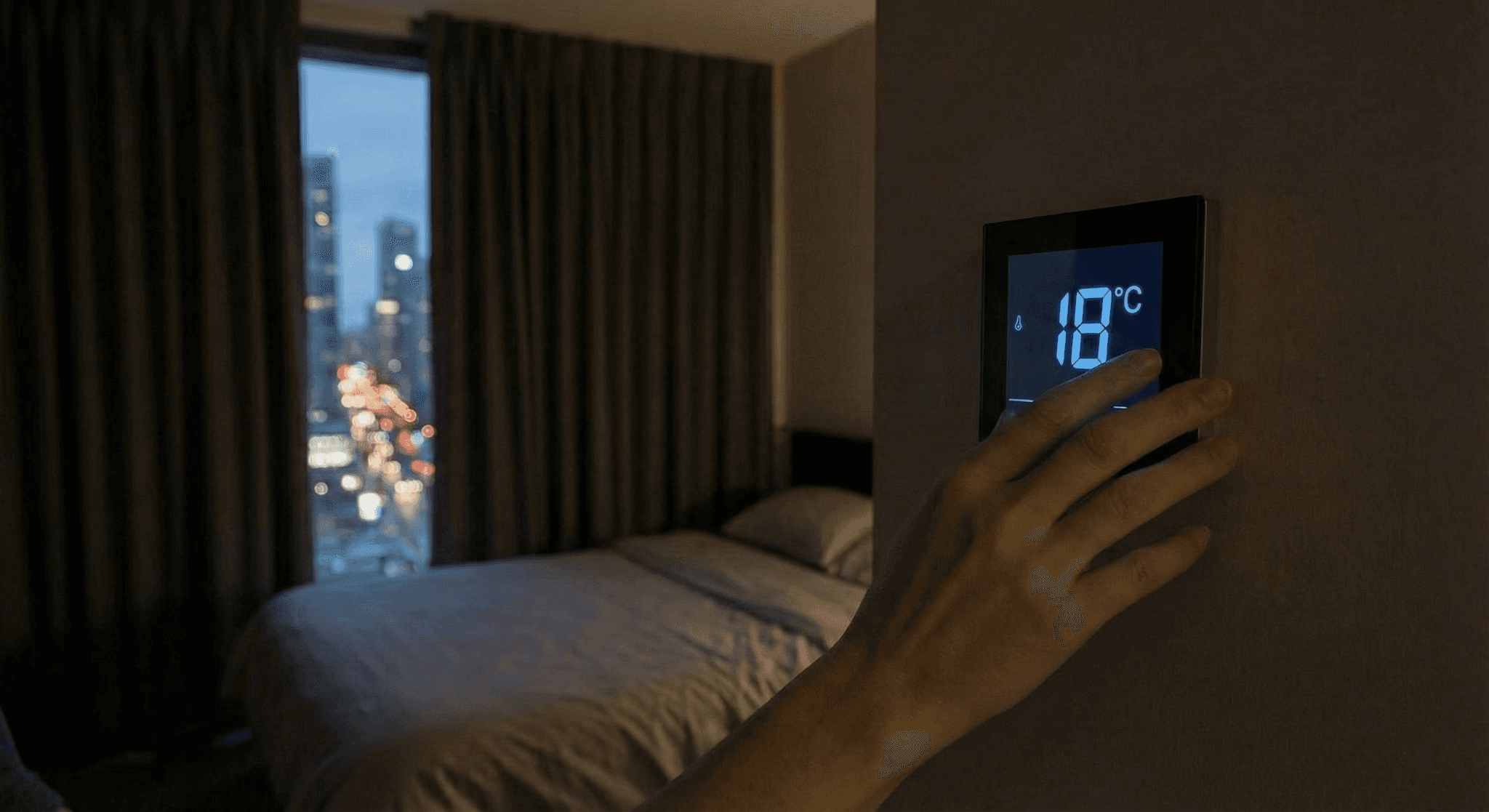
The Magic Number: 16–19°C
Sleep scientists have identified an optimal temperature range through years of research, and it's colder than most people keep their bedrooms: between 16 and 19 degrees Celsius (60 to 67 degrees Fahrenheit), according to guidelines from the National Sleep Foundation.
When bedroom temperatures climb above 20 or 21 degrees, multiple studies document the same cascade of problems: reduced sleep efficiency, more time spent awake after initially falling asleep, and notably less deep sleep—the stage most crucial for physical recovery and cognitive function.
Why this specific range? It supports three critical processes: heat loss through your hands and feet, stable melatonin secretion, and reduced activity in your sympathetic nervous system—the part of your brain that keeps you alert and ready for action.
As one research team studying thermoregulation and sleep put it: comfort is subjective, but biology is not.
The Melatonin Connection
Melatonin has earned its reputation as the “sleep hormone,” but that label understates its true physiological role. Beyond signaling to the brain that darkness has fallen, melatonin actively initiates the cooling of the body that makes sleep possible. As melatonin levels rise in the evening, it increases heat loss through peripheral blood vessels, particularly in the hands, feet, and skin surface, allowing core body temperature to decline. This drop in core temperature is not a byproduct of sleep; it is a biological prerequisite for sleep onset and deep sleep.
As illustrated in the chart above, melatonin secretion begins to rise in the late evening, while core body temperature peaks earlier in the day and then gradually falls, reaching its lowest point during the night. These two curves are tightly connected: as melatonin rises, core temperature falls, creating the physiological window in which the body can transition into sustained, restorative sleep. Toward morning, melatonin levels decline and core body temperature begins to rise again, preparing the body for wakefulness and alertness.
Deep Sleep Suffers Most
Of all the sleep stages, deep sleep—formally called Stage N3 or slow-wave sleep—is the most vulnerable to temperature disruption.
This matters because deep sleep does the heavy lifting: tissue repair, growth hormone secretion, immune function, and memory consolidation all happen predominantly during this stage. Skimp on deep sleep, and you'll feel the effects even if you technically spent eight hours in bed.
Experimental studies published in the journal Sleep found that elevated ambient temperatures can slash deep sleep duration by 10 to 30 percent, even when total sleep time stays the same. Researchers also documented higher nighttime heart rates, increased autonomic arousal, and more micro-awakenings in warmer conditions—changes that occur before people consciously register discomfort.
Your sleep quality declines before you even realise you're too warm.
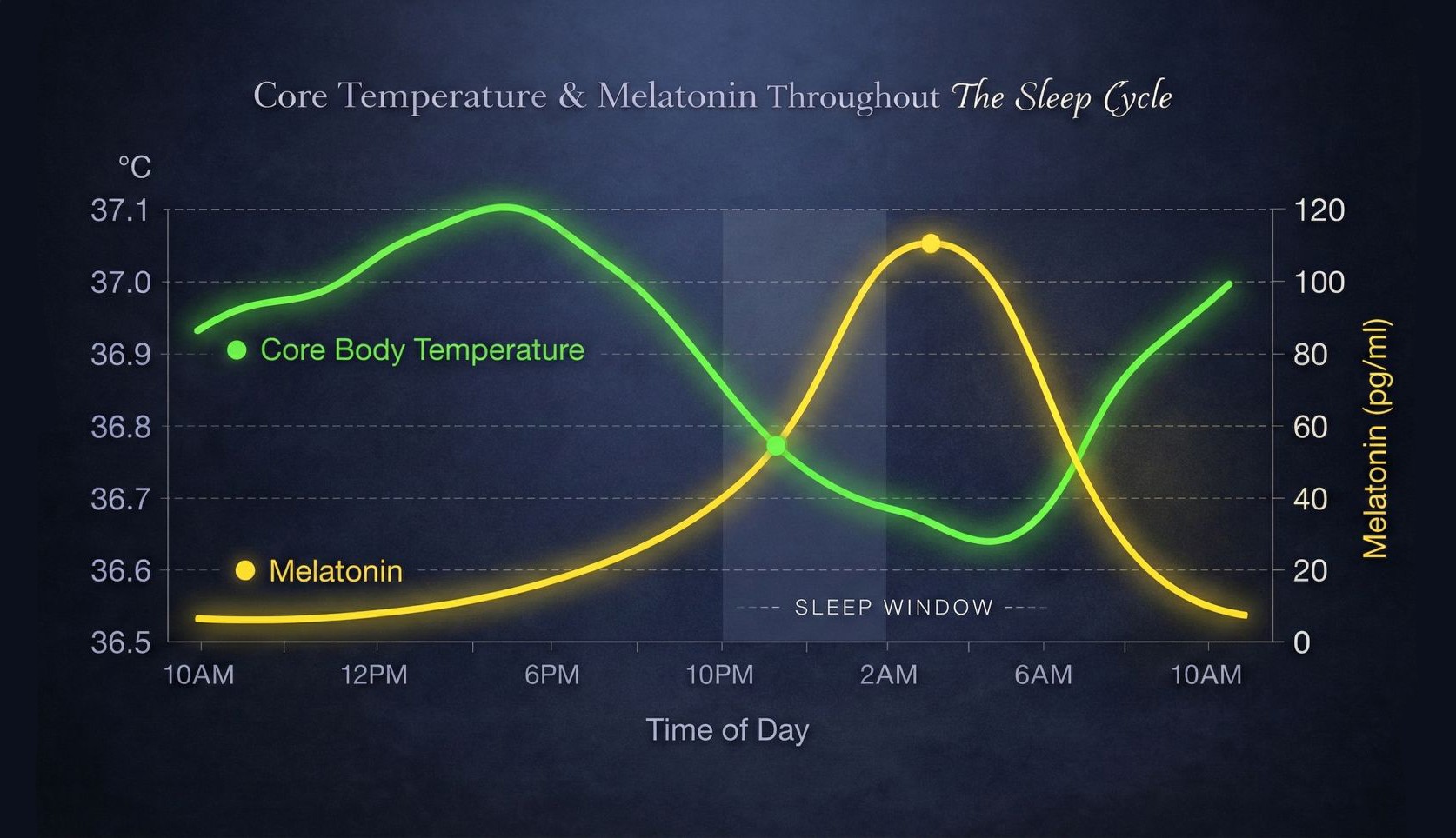
Source: Adapted from circadian physiology data published in Alzheimer’s in the Post-Industrial Epoch
The Cooling Technology Alternative
In many climates and living situations, maintaining a bedroom temperature of 16 to 18 degrees Celsius simply isn't practical or affordable. Air conditioning isn't universal, especially in temperate climates where homes lack cooling infrastructure.
This reality has driven innovation in localised cooling technology. Rather than cooling an entire room, systems like Eight Sleep or Chilipad focus on cooling the body directly through temperature-controlled water circulated through a mattress layer.
Research published in Nature Neuroscience on targeted thermal manipulation during sleep found measurable benefits: faster sleep onset, increased time in both deep and REM sleep, lower nighttime heart rate, and fewer nocturnal awakenings.
The physiological logic is sound. Your body needs to lose heat, not experience freezing air. Targeted cooling addresses the core problem without requiring you to shiver under your covers.

Source: Screenshot from Eight Sleep App
Practical Steps Forward
The evidence points toward several concrete actions:
Prioritise room temperature between 16 and 19 degrees Celsius where feasible. Yes, this feels cold initially, but your body under blankets will appreciate the ambient coolness.
Choose breathable materials for both bedding and mattresses. Natural fibers like cotton, linen, and wool regulate temperature better than synthetics.
Avoid heat-generating activities close to bedtime. Both alcohol consumption and late-night exercise increase core body temperature and interfere with the cooling process needed for sleep.
Consider localised cooling when controlling room temperature proves impractical. Technologies targeting the sleep surface rather than the air may offer a more efficient solution.
Designing for Sleep
Perhaps the biggest shift is conceptual. Sleep isn't something you achieve through willpower or the right supplement regimen. Sleep is something you design for, an environmental outcome shaped by temperature, light, air quality, and material choices.
When these elements align with human physiology rather than fighting against it, sleep becomes less of a nightly struggle and more of a natural process. Not optimised. Not hacked. Simply supported.
Temperature represents one of the most overlooked yet fundamental pillars of that support system. The thermostat setting you chose months ago without much thought might matter more than your meditation app.
Might be worth checking before bed tonight.


Ready to shape a healthier future?
Book an introductory conversation to explore how well-being can be integrated into your space or project
Ready to shape a healthier future?
Book an introductory conversation to explore how well-being can be integrated into your space or project
Ready to shape a healthier future?
Book an introductory conversation to explore how well-being can be integrated into your space or project
Resources & insights
The Cool Truth About Better Sleep
7 min read
January 18, 2026
You've tried the sleep apps. You've cut the caffeine after 2 PM. You've invested in blackout curtains and a white noise machine. Yet you still wake up frustrated, wondering why sleep feels like such hard work.
The answer might be simpler, and more uncomfortable, than you think. Your bedroom is probably too hot.
The Biology of Sleep Isn't What You Think
Most of us treat sleep like a light switch: get tired, lie down, drift off. But the reality is far more complex. Sleep isn't just about exhaustion—it's about temperature.
When evening arrives, your body doesn't simply shut down. It initiates a carefully orchestrated cooling process, dropping your core temperature by roughly 1 to 1.5 degrees Celsius, according to research published in Sleep Medicine Reviews. This isn't a side effect of falling asleep. It's the mechanism that makes sleep possible in the first place.
Think of it this way: you don't fall asleep because you're relaxed. You fall asleep because your body successfully cools down.
When that cooling process gets disrupted—by a warm bedroom, heavy blankets, or even stress hormones—the consequences ripple through your entire night. Studies show that when the body can't lower its temperature effectively, people take longer to fall asleep, wake more frequently during the night, and spend less time in the deep, restorative stages of sleep that actually matter.
The Magic Number: 16–19°C
Sleep scientists have identified an optimal temperature range through years of research, and it's colder than most people keep their bedrooms: between 16 and 19 degrees Celsius (60 to 67 degrees Fahrenheit), according to guidelines from the National Sleep Foundation.
When bedroom temperatures climb above 20 or 21 degrees, multiple studies document the same cascade of problems: reduced sleep efficiency, more time spent awake after initially falling asleep, and notably less deep sleep—the stage most crucial for physical recovery and cognitive function.
Why this specific range? It supports three critical processes: heat loss through your hands and feet, stable melatonin secretion, and reduced activity in your sympathetic nervous system—the part of your brain that keeps you alert and ready for action.
As one research team studying thermoregulation and sleep put it: comfort is subjective, but biology is not.
The Melatonin Connection
Melatonin has earned its reputation as the “sleep hormone,” but that label understates its true physiological role. Beyond signaling to the brain that darkness has fallen, melatonin actively initiates the cooling of the body that makes sleep possible. As melatonin levels rise in the evening, it increases heat loss through peripheral blood vessels, particularly in the hands, feet, and skin surface, allowing core body temperature to decline. This drop in core temperature is not a byproduct of sleep; it is a biological prerequisite for sleep onset and deep sleep.
As illustrated in the chart above, melatonin secretion begins to rise in the late evening, while core body temperature peaks earlier in the day and then gradually falls, reaching its lowest point during the night. These two curves are tightly connected: as melatonin rises, core temperature falls, creating the physiological window in which the body can transition into sustained, restorative sleep. Toward morning, melatonin levels decline and core body temperature begins to rise again, preparing the body for wakefulness and alertness.
Source: Adapted from circadian physiology data published in Alzheimer’s in the Post-Industrial Epoch
Deep Sleep Suffers Most
Of all the sleep stages, deep sleep—formally called Stage N3 or slow-wave sleep—is the most vulnerable to temperature disruption.
This matters because deep sleep does the heavy lifting: tissue repair, growth hormone secretion, immune function, and memory consolidation all happen predominantly during this stage. Skimp on deep sleep, and you'll feel the effects even if you technically spent eight hours in bed.
Experimental studies published in the journal Sleep found that elevated ambient temperatures can slash deep sleep duration by 10 to 30 percent, even when total sleep time stays the same. Researchers also documented higher nighttime heart rates, increased autonomic arousal, and more micro-awakenings in warmer conditions—changes that occur before people consciously register discomfort.
Your sleep quality declines before you even realise you're too warm.
The Cooling Technology Alternative
In many climates and living situations, maintaining a bedroom temperature of 16 to 18 degrees Celsius simply isn't practical or affordable. Air conditioning isn't universal, especially in temperate climates where homes lack cooling infrastructure.
This reality has driven innovation in localised cooling technology. Rather than cooling an entire room, systems like Eight Sleep or Chilipad focus on cooling the body directly through temperature-controlled water circulated through a mattress layer.
Research published in Nature Neuroscience on targeted thermal manipulation during sleep found measurable benefits: faster sleep onset, increased time in both deep and REM sleep, lower nighttime heart rate, and fewer nocturnal awakenings.
The physiological logic is sound. Your body needs to lose heat, not experience freezing air. Targeted cooling addresses the core problem without requiring you to shiver under your covers.
Source: Screenshot from Eight Sleep App
Practical Steps Forward
The evidence points toward several concrete actions:
Prioritise room temperature between 16 and 19 degrees Celsius where feasible. Yes, this feels cold initially, but your body under blankets will appreciate the ambient coolness.
Choose breathable materials for both bedding and mattresses. Natural fibers like cotton, linen, and wool regulate temperature better than synthetics.
Avoid heat-generating activities close to bedtime. Both alcohol consumption and late-night exercise increase core body temperature and interfere with the cooling process needed for sleep.
Consider localised cooling when controlling room temperature proves impractical. Technologies targeting the sleep surface rather than the air may offer a more efficient solution.
Designing for Sleep
Perhaps the biggest shift is conceptual. Sleep isn't something you achieve through willpower or the right supplement regimen. Sleep is something you design for, an environmental outcome shaped by temperature, light, air quality, and material choices.
When these elements align with human physiology rather than fighting against it, sleep becomes less of a nightly struggle and more of a natural process. Not optimised. Not hacked. Simply supported.
Temperature represents one of the most overlooked yet fundamental pillars of that support system. The thermostat setting you chose months ago without much thought might matter more than your meditation app.
Might be worth checking before bed tonight.
Resources & insights
The Cool Truth About Better Sleep
7 min read
January 18, 2026
You've tried the sleep apps. You've cut the caffeine after 2 PM. You've invested in blackout curtains and a white noise machine. Yet you still wake up frustrated, wondering why sleep feels like such hard work.
The answer might be simpler, and more uncomfortable, than you think. Your bedroom is probably too hot.
The Biology of Sleep Isn't What You Think
Most of us treat sleep like a light switch: get tired, lie down, drift off. But the reality is far more complex. Sleep isn't just about exhaustion—it's about temperature.
When evening arrives, your body doesn't simply shut down. It initiates a carefully orchestrated cooling process, dropping your core temperature by roughly 1 to 1.5 degrees Celsius, according to research published in Sleep Medicine Reviews. This isn't a side effect of falling asleep. It's the mechanism that makes sleep possible in the first place.
Think of it this way: you don't fall asleep because you're relaxed. You fall asleep because your body successfully cools down.
When that cooling process gets disrupted—by a warm bedroom, heavy blankets, or even stress hormones—the consequences ripple through your entire night. Studies show that when the body can't lower its temperature effectively, people take longer to fall asleep, wake more frequently during the night, and spend less time in the deep, restorative stages of sleep that actually matter.
The Magic Number: 16–19°C
Sleep scientists have identified an optimal temperature range through years of research, and it's colder than most people keep their bedrooms: between 16 and 19 degrees Celsius (60 to 67 degrees Fahrenheit), according to guidelines from the National Sleep Foundation.
When bedroom temperatures climb above 20 or 21 degrees, multiple studies document the same cascade of problems: reduced sleep efficiency, more time spent awake after initially falling asleep, and notably less deep sleep—the stage most crucial for physical recovery and cognitive function.
Why this specific range? It supports three critical processes: heat loss through your hands and feet, stable melatonin secretion, and reduced activity in your sympathetic nervous system—the part of your brain that keeps you alert and ready for action.
As one research team studying thermoregulation and sleep put it: comfort is subjective, but biology is not.
The Melatonin Connection
Melatonin has earned its reputation as the “sleep hormone,” but that label understates its true physiological role. Beyond signaling to the brain that darkness has fallen, melatonin actively initiates the cooling of the body that makes sleep possible. As melatonin levels rise in the evening, it increases heat loss through peripheral blood vessels, particularly in the hands, feet, and skin surface, allowing core body temperature to decline. This drop in core temperature is not a byproduct of sleep; it is a biological prerequisite for sleep onset and deep sleep.
As illustrated in the chart above, melatonin secretion begins to rise in the late evening, while core body temperature peaks earlier in the day and then gradually falls, reaching its lowest point during the night. These two curves are tightly connected: as melatonin rises, core temperature falls, creating the physiological window in which the body can transition into sustained, restorative sleep. Toward morning, melatonin levels decline and core body temperature begins to rise again, preparing the body for wakefulness and alertness.
Source: Adapted from circadian physiology data published in Alzheimer’s in the Post-Industrial Epoch
Deep Sleep Suffers Most
Of all the sleep stages, deep sleep—formally called Stage N3 or slow-wave sleep—is the most vulnerable to temperature disruption.
This matters because deep sleep does the heavy lifting: tissue repair, growth hormone secretion, immune function, and memory consolidation all happen predominantly during this stage. Skimp on deep sleep, and you'll feel the effects even if you technically spent eight hours in bed.
Experimental studies published in the journal Sleep found that elevated ambient temperatures can slash deep sleep duration by 10 to 30 percent, even when total sleep time stays the same. Researchers also documented higher nighttime heart rates, increased autonomic arousal, and more micro-awakenings in warmer conditions—changes that occur before people consciously register discomfort.
Your sleep quality declines before you even realise you're too warm.
The Cooling Technology Alternative
In many climates and living situations, maintaining a bedroom temperature of 16 to 18 degrees Celsius simply isn't practical or affordable. Air conditioning isn't universal, especially in temperate climates where homes lack cooling infrastructure.
This reality has driven innovation in localised cooling technology. Rather than cooling an entire room, systems like Eight Sleep or Chilipad focus on cooling the body directly through temperature-controlled water circulated through a mattress layer.
Research published in Nature Neuroscience on targeted thermal manipulation during sleep found measurable benefits: faster sleep onset, increased time in both deep and REM sleep, lower nighttime heart rate, and fewer nocturnal awakenings.
The physiological logic is sound. Your body needs to lose heat, not experience freezing air. Targeted cooling addresses the core problem without requiring you to shiver under your covers.
Source: Screenshot from Eight Sleep App
Practical Steps Forward
The evidence points toward several concrete actions:
Prioritise room temperature between 16 and 19 degrees Celsius where feasible. Yes, this feels cold initially, but your body under blankets will appreciate the ambient coolness.
Choose breathable materials for both bedding and mattresses. Natural fibers like cotton, linen, and wool regulate temperature better than synthetics.
Avoid heat-generating activities close to bedtime. Both alcohol consumption and late-night exercise increase core body temperature and interfere with the cooling process needed for sleep.
Consider localised cooling when controlling room temperature proves impractical. Technologies targeting the sleep surface rather than the air may offer a more efficient solution.
Designing for Sleep
Perhaps the biggest shift is conceptual. Sleep isn't something you achieve through willpower or the right supplement regimen. Sleep is something you design for, an environmental outcome shaped by temperature, light, air quality, and material choices.
When these elements align with human physiology rather than fighting against it, sleep becomes less of a nightly struggle and more of a natural process. Not optimised. Not hacked. Simply supported.
Temperature represents one of the most overlooked yet fundamental pillars of that support system. The thermostat setting you chose months ago without much thought might matter more than your meditation app.
Might be worth checking before bed tonight.